



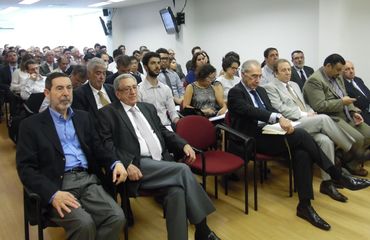
São Paulo – As Brazil struggles with multiple economic challenges, its protectionism ultimately does more harm than good to national companies. So says economist Octavio de Barros, CEO of Instituto República and a former chief economist with Bradesco. Barros discussed the Brazilian and international economies this Wednesday (15) during a breakfast for Arab Brazilian Chamber of Commerce member companies.
“Brazil is the most protectionist country in the world. It should be focusing on productivity and efficiency instead,” he said, stressing that overprotecting national companies isn’t the best approach to spurring growth. “The damage Brazilian protectionism does to businesses outweighs whatever benefits it brings,” said Barros.
He also said fighting for access to markets means nothing if Brazil does not open its own doors to foreign product. Barros believes multilateral agreements aren’t the best approach to international trade. “I prefer bilateral and regional agreements, because the multilateral approach has failed to bring about progress for Brazil.” According to Barros, “Brazil needs to send out signals to the world that it intends to open up.”
Regarding the international economy, Barros said that there is no longer a “global powerhouse” like the United States or Europe used to be. “The United States cannot bear the brunt of the world economy alone,” he pointed out.
The economist said world leaders have switched roles, as US president Donald Trump espouses shutting down the borders and increasing protection to the national industry, whereas China’s president Xi Jinping calls for openness in international trade.
Arab market
During the event, Arab Chamber CEO Michel Alaby gave an overview of business opportunities available in Middle East and North Africa countries.
“According to the IMF, the growth expectation for Arab countries in 2017 is 3%,” he said. Alaby went over the biggest projects underway in the Arab world, such as Expo 2020, which the United Arab Emirates will host, and the 2022 FIFA World Cup in Qatar.
The CEO said Brazil’s exports list to Arab countries is topped by sugar, meats and ore, but there are opportunities to be explored in other industries. “This lack of variety needs to change, and the Arab Chamber is working to broaden that range.”
Activities in 2017
Arab Chamber president Rubens Hannun revealed the calendar for the first half of the year, after noting that although exports from Brazil declined in 2016, sales to Arab countries dropped at a slower rate. “Exports to Arab countries declined the least,” he stressed. Hannun also said it’s important for Brazilian exporting companies to follow through in their relations with Arab importers.
He went on to discuss the action plans for early on in the year, including several activities in tandem with Arab embassies in Brazil; a mission to Saudi Arabia this month; the Abu Dhabi defense industry expo Idex; a visit to the offices of the League of Arab States in Egypt; and the Gulfood expo in Dubai.
In March, the Chamber will welcome the UAE’s minister of Foreign Affairs and International Cooperation, as well as celebrate the Day of the Arab Community in Brazil. In April, the city of Foz do Iguaçu will host a meeting of the General Union of Chambers of Commerce, Industry and Agriculture for Arab Countries. In May, the Arab Chamber will participate in the fair of the São Paulo Supermarkets Association (Apas), in São Paulo, and in the Middle East Stone Fair in Dubai.
Mission to North Africa
Márcio Guerra, an International Business analyst with the Brazilian Trade and Investment Promotion Agency (Apex-Brasil), discussed the schedule of a mission that will see Brazilian executives travel to North Africa from April 18 to 26, as ANBA has previously reported. The mission to Morocco, Egypt and Algeria is being organized by Apex-Brasil and the Brazilian Foreign Ministry, with backing from the Arab Chamber.
In Meknés, Morocco, the Brazilians will showcase products at the International Agriculture Show, which features food and beverages, agricultural equipment and other related equipment.
In Egypt and Algeria, they will sit down for matchmaking sessions with local importers to offer food and beverage items, machinery and equipment, home and construction products, and pharmaceuticals.
Registration for businesses looking to join the mission are open until Friday (17) at http://arq.apexbrasil.com.br/emails/missoes/norteafrica/05/index.htm
*Translated by Gabriel Pomerancblum

