


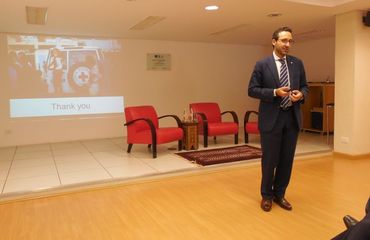
São Paulo – The International Committee of the Red Cross (ICRC) wants to raise awareness among Brazilians to contribute with its work. The international organization works with protection and assistance to victims of armed conflicts and tensions, and the ICRC’s head of operations for the Middle East, Robert Mardini, came to Brazil in this last week to talks with the public and privates sectors about the issue. One of Mardini’s appointments was at the Arab Brazilian Chamber of Commerce, on Friday (30th), where he spoke to staff members and executives of the organization, among them the CEO Michel Alaby.
The international organization will open an office next year in the city of São Paulo, which will work on recruiting professionals to ICRC, but that it wants, besides having Brazilians in its staff, the financial collaboration of the public sector, companies and population in general to its operations, especially in the Middle East. Mardini said that the intensity of the conflicts in the region is increasing and told about the ICRC operations in places such as Syria, Iraq, Palestine, Yemen and surrounding areas, including the ones receiving refugees from the wars.
Due to the exacerbation of the issues in the region, there’s a need for a greater support to the ICRC operations. The organization’s budget for the Near and Middle East, which stood at 278.6 million Swiss francs (USD 289.8 million at the current exchange rate), will jump to 414.9 million Swiss francs (USD 418.1 million) this year and to 465 million Swiss francs (USD 468.6 million) next year.
Mardini said that the main causes of the conflicts still persist and warned for the multiplicity and radicalization of the armed groups in the region, the increasing regional competition, the humanitarian devastation, the massive displacement of the population, with a crisis of migration and refugees. According to data presented by the head of operations, the ICRC has a resident team of 2,346 people in the region and a mobile team of 430 members. There was an increase of 14% in the resident team and of 13% in the mobile team from 2014 to 2015.
Mardini listed some actions by ICRC in the current Middle East conflicts. In Syria, he showed, for instance, the help to those hit in the war front, to hospitals; in Iraq, the food distribution; and in Palestine, the mediation for the free movement of ambulances, railway rebuilding, among other activities. Differently from the common sense, the ICRC doesn’t operate only on health assistance to those hit by wars, but it also has a series of initiatives that help the population to resume life.
The manager for Resource Mobilization and Partnerships at ICRC, Flávio de Mattos Franco, told ANBA about the work that the organization does with water resources, for instance. One of the first concerns for ICRC is to guarantee water treatment and pumping, so the population is able to do the basics such as clean wounds and avoid contaminated food. “It eases the pressure on health assistance”, he says.
In addition to this, the ICRC works to reestablish the economic life of the population, rebuild the infrastructure, resume electrical energy (crucial for hospitals’ operations), produce prosthesis and orthesis. When the ICRC was founded, the work was focused especially for the aid to soldiers, since the front was on a determined place, away from the population. Today, the conflicts happen in the middle of the cities, with the soldiers equipped and protected, with civilians unprotected. Because of this, according to Franco, ICRC’s operations are focused mainly on the population.
The ICRC is based in Geneva and works in partnership with domestic organizations, such as the Red Crescent in some Muslim countries, and the Red Cross in Brazil. Despite working together, they are independent organizations. Mardini landed in Brazil on Wednesday (28th) and stayed until Friday (30th). He was followed by members of the Regional Delegation of the organization for Argentina, Brazil, Chile, Paraguay and Uruguay, which is based in Brasília.
Currently, Brazil isn’t a permanent donor of ICRC. But representatives of the organization that visited Brazil expressed their desire of receiving regular donations by the Brazilian public sector, and also by the population and private sector. Brazilians interested in donating to the organization can do it via the website. Companies can contact them via phone or email (below). According to Franco, depending on the amount donated by a company, it can issue- (amputation, etc) or country-oriented. Each case must be assessed. If it’s a small donation, it will go to the general budget, which prioritizes conflicts in evidence or the most problematic situations around the world.
Service:
To donate to ICRC (individual):
https://www.icrc.org/pt/
To donate to ICRC (companies and public sector):
Contact Flávio de Mattos Franco
Telefone: +55 (61) 3106-2350
Email: [email protected]
*Translated by Sérgio Kakitani
