



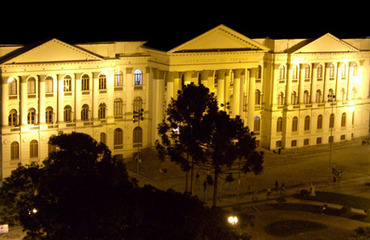
São Paulo – Refugees may apply for graduate courses at the Federal University of Paraná (UFPR) next year. Up until November 13th, the institution will be accepting enrolments from humanitarian or refugee visa holders who were attending graduate courses in their countries of origin and wish to continue their studies in Brazil. Last year, the university admitted 11 students in these conditions. Most were Syrian, according to information from UFPR deputy provost Rogério Andrade Mulinari.
Mulinari claims Paraná is the state with the second highest number of refugees in Brazil, trailing São Paulo, and that the UFPR believes these foreigners can contribute to the state’s economy by following through with their studies “instead of competing in a second-tier market,” Mulinari told ANBA over the phone. This belief is what drove the institution to implement the initiative. The majority of enrollees are Syrian, followed by Haitians, people from the African continent and Colombians.
Refugees are assigned positions left idle due to transfers or dropouts. Therefore, there is no set number of slots. The UFPR intends for this year’s candidates to start attending classes in 2016, but this will hinge of the availability of openings in each course. “It could be that they are accepted but cannot start right away, in which case they’ll have to wait for a new opening,” the deputy provost explains.
The foreigners will be allowed to enter courses equal to the ones they were taking in their countries, or similar ones, in case the same course is not available. As a case in point, Mulinari cites an Aeronautical Engineering candidate. Since the university does not offer this course, he was allowed to choose between Electrical or Mechanical Engineering. Each of the refugees approved will have a tailor-made academic adaptation program, according to the deputy provost.
The students will need to take a course in Portuguese for foreigners offered by UFPR, and will be overseen by a tutor professor and a tutor student who will assist them with any needs that may arise, especially language-wise. “The news I get from these strategies are leading to successful inclusions,” says Mulinari.
To apply, foreigners must enjoy legal refugee status or have humanitarian visas. Among other documents, they must present a filled out form, their school records, and a passport or equivalent document at the Room of Extension Project “Migrations, Asylum and Hospitality” (Projeto de Extensão “Migrações, Refúgio e Hospitalidade”), at the UFPR’s Legal Sciences Center (Centro de Ciências Jurídicas). Mulinari explains that not all applicants are approved, since some are unable to attest that they were taking courses in their countries, for instance.
Selection of refugees for graduate courses at UFPR
Enrolments open from October 14th to November 13th, 2015
Classes begin in 2016 (subject to availability)
Additional information: http://www.ufpr.br/portalufpr/wp-content/uploads/2015/10/Edital-004_2015-Refugiados1.pdf
*Translated by Gabriel Pomerancblum
