



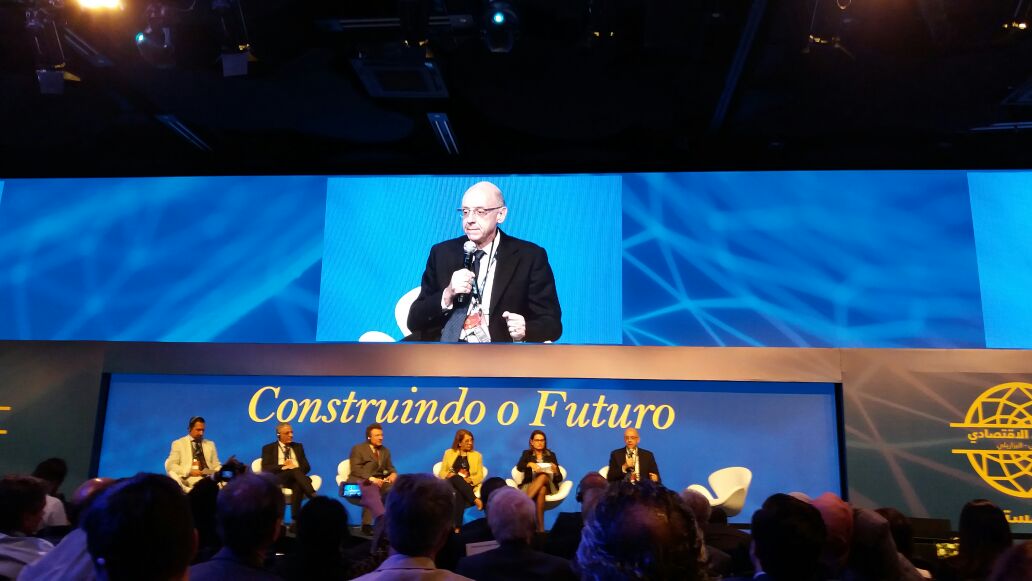
São Paulo – To produce renewable energy contributes to reduce unemployment in the countries that adopt it, stated Plínio Nastari, the president of agricultural consulting firm Datagro and member of the National Council of Energy Policy (CNPE), in a panel on the issue at the Brazil-Arab Countries Economic Forum, which is taking place in São Paulo this Monday (02).
“Let’s produce more bioenergy,” said Nastari to the audience and to the representatives of Arab countries in attendance. Datagro’s president talked about RenovaBio, a policy implemented in Brazil that sets a strategy for the development of biofuels in the Brazilian energy matrix, as an example for the world.
“I tell many of the world’s countries why it (RenovaBio) is so important: because it generates jobs. It not only solves the problem of meeting the climate’s targets, but it also generates jobs, which is what will be lacking for humanity in the next few years,” said Nastari, mentioning the settlement of part of the population in the country’s rural areas as a result of the production of bioenergy.
Nastari told the Arabs of the use of ethanol in Brazil, which is mixed to gasoline (27% of the total), is used as fuel in the country’s flex-fuel fleet and has its bagasse (cane waste) forwarded for power production in the plants. According to Datagro’s president, Brazil avoided spending USD 416 billion in gasoline imports due to ethanol production as fuel.
Alessandra Amaral, president of Energisa, was also a speaker during the panel and showed Brazil’s heavy investment in renewable sources, with 80% of the country’s power generation coming from this matrix. The country currently has a 148 GW power capacity and should move to 212 GW with an increase in the use of energies such as solar and wind.
The general manager and CEO of World Trade Center Algeria, Ahmed El Antri Tibaoui, painted a general picture of the use of renewable energy in the Arab countries. He mentioned many Arab nations investing in the area, such as Qatar, Tunisia, with its solar energy projects, Saudi Arabia, Algeria and the emirate of Abu Dhabi (with 25% of its power generated by a renewable source). “All of the countries are seeking this,” he said.
The senior manager of Government Relations of the Dubai Electricity & Water Authority (DEWA), Saeed Bel Jafla, talked about Dubai’s initiatives in the area. According to him, the emirate has the world’s largest solar energy park and great experts in renewable energy.
Dubai’s working to increase it renewable energy capacity and, according to Jafla, the task will be possible with the support of experts “from this part of the world” (referring to Brazil and region), which will join their experts. The manager said that the emirate uses electric cars and currently has over 100 charging stations, a number that will surpass 200 until 2020.
The panel’s mediator was Suani Coelho, from the Institute of Energy and Environment of the University of São Paulo (USP), and by the president and CEO of the National US-Arab Chamber of Commerce, David Hamood. Hamood said that all of the Arab countries are currently focused on doing the transition from a hydrocarbons-based to a renewable energy-based economy.
The Brazil-Arab Countries Economic Forum was jointly organized by the Arab Brazilian Chamber of Commerce and the Union of Arab Chambers, with the support of the Arab League.
Translated by Sérgio Kakitani
