


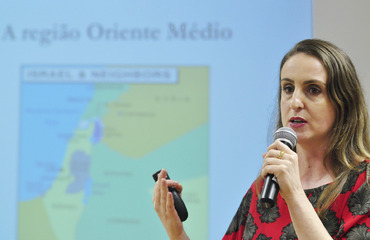
São Paulo – Silvia Ferabolli, a native of Brazil’s Rio Grande do Sul state with two books on the Arab world published and a professor of International Relations, believes in the integration of Arab countries as the best option for cooperation in the region. This was the message she conveyed on Wednesday (13th) in a lecture on the topic at the Arab Brazilian Chamber of Commerce, in São Paulo, during which she also listed the jointly-made progress Arab nations have made. The lecture was attended by approximately 30 people, including executives, students, Arab Chamber leaders and people interested in the subject.
“There is much more regional cooperation in the Arab world than we can imagine, so long as we rid ourselves of the notion that the only possible way to organize an intraregional group of states is by mimicking the European Union cooperation model,” said the lecturer, whose books on the topic are the outcome of her master’s and doctorate theses, the latter of which she completed at the School of Oriental and African Studies of the University of London.
According to Ferabolli, there are three types of regionalism vying for the region that stretches from the Gulf to the Atlantic Ocean. One of is the New Middle East, supported by Shimon Peres and backed by the United States, whereby Israel would become the region’s focal point. The other one is Union for the Mediterranean, an official plan to integrate the Mediterranean Arab countries plus Turkey and Israel with the European Union, but according to the scholar, Europe’s true intention is to pass on its security costs in the region to Arabs.
The other integration project for the region is centered on the Arab states. “My thesis is that the project for Arab cooperation shows much higher levels of success,” she claimed. According to her, since the last century, Arab states and citizens are involved in a regional construction process that unfolds in an irregular, unstable, imperfect way. “The enlarged Arab Free Trade Area is imperfect, but name one perfect free trade area and I’ll clap my hands for twenty minutes on end,” she said.
According to the lecturer, as soon as one mentions Arab projects, people get an “ill disposition.” Ferabolli said studies on the "Greater Arab Free Trade Area" (Gafta) tend to only highlight the problems. She recalled past attempts at establishing Arab free trade areas, in 1953, 1964 and 1981 that didn’t quite go through, but on the other hand: “the Arabs gradually learned how not to create a free trade area.”
According to her, the correction of those errors is today’s Gafta. As examples of regional integration, Ferabolli mentioned income transfer from richer to poorer areas and Foreign Direct Investment (FDI) among Arab countries. Ferabolli claims the Gulf Cooperation Council countries account for 36% of FDI flows in the Arab world.
She mentioned the sovereign funds of Kuwait, Abu Dhabi and Saudi Arabia, which boast the world’s highest donation-to-GDP ratios, and the funds of the Arab Bank for Economic Development in Africa (Abeda), the Organization of Petroleum Exporting Countries (Opec) and the Islamic Development Bank (IBD), which are Arab-run. According to the researcher, the latest studies show that an Arab country is 22 times more likely to get funding from any of these funds than a non-Arab country.
Ferabolli also spoke on other aspects of successful cooperation among Arabs, including expatriate worker flows and the ensuing exchange of ideas, and even forced migration, whereby refugees are taken in from conflict-ridden countries. The fact that there are “highly renowned” Arab universities also enables citizens to move to another country to get an education, while being able to trust their neighbor completely and know they speak the same language. According to Ferabolli, the region’s great strength resides in human and individual relationships.
She also discussed the progress made at summit meetings held by the Arab League, including Arabsat, a satellite operator that serves several Arab countries, and the joint trade agreement entered into with China. She also noted that in order to tap into the Arab funds, one must be an Arab or partner up with one.
Ferabolli questioned why, considering all these things, studies on local regionalism are neglected. And she gave her explanation. “The Arab organizations and institutions are designed, directed and operated by Arab citizens. This means European and American internationalists who don’t speak Arabic cannot work for these institutions, hold leadership positions or give orders in the Arab forums, organizations and institutions,” she said.
The event was part of the Arab Chamber Lecture Cycle, which features specialists in fields such as culture, international trade and economy. Ferabolli’s lecture was introduced by the Chamber’s president Marcelo Sallum and former director Mário Rizkallah played host. Other Arab Chamber C-level executives attended, including CEO Michel Alaby and Foreign Trade vice president Rubens Hannun.
*Translated by Gabriel Pomerancblum
