


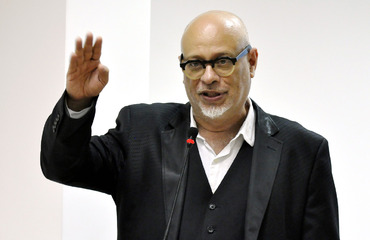
São Paulo – Imagine a society where the people are consumers of relationships and see them as goods. This is what is happening with contemporary world, in which people are increasingly focused on themselves, and a school of marketing, called existential, studies the trend to know how to sell better. These were the main ideas introduced this Wednesday (11) by philosopher Luiz Felipe Pondé, in a lecture at the Arab Brazilian Chamber of Commerce, where he showed how marketing interprets contemporary mankind.
Pondé, holder of doctor’s degrees in Philosophy from the University of São Paulo (USP) and Paris VIII University, covers this universe in his classes at universities and in his work of behavior analysis for advertising agencies. The research in human behavior is one of the fields of study of the philosopher, who is also a writer and columnist in Brazilian news outlets.
“The narcissicstic behavior is a rising trend in contemporary society”, said Pondé to the audience. He mentioned the forecasts on 20th century society done by the North American historian Christopher Lasch in his book “The Culture of Narcissism”, from 1979. According to the philosopher, Lasch said that people would be more worried with one’s self than with the other, and people would stand up for a cause more to feel better about themselves than to produce results. “Social concerns are very much subjected to narcissism”, he said.
And this currently happens to love relationships also, says Pondé. “Relationships tend to be ephemeral; people enter them as if they are at the stock exchange. You’re with the person, but checking out the market”, says the philosopher, adding that they put effort in relationships if they produce results, benefits for them. This narcissistic society produces too much loneliness and favors the market, according to the college professor. “This helps people to buy a lot. If you have nobody, you buy”, concluded Pondé.
He also said that the low-income middle class has a stronger community environment and that the more material resources available, more people tend to make choices thinking on themselves. “The more options people have, more individualized choices they make”, he says. The children of the low-income middle class, according to Pondé, respect more their parents, speak better Portuguese than their parents, earn more than their parents, and feel bad about all this. When they start to live together with people of better incomes, they think rich people are worthless and only think about Money.
In the contemporary world, people enter relationships as if they are consumers, and also seek in the goods a behavior value associated with them. “The market offers options so you can feel you’re being critical; if you ride a bike you have the impression that you’re a more advanced person than the one driving a car, that you’re carrying the redemption of the planet”, he said. “The idea that you travel to go through an anthropological experience is the coolest thing of all”, he says, about another consumer product full of meaning.
This is a way out for young people that carry the impression that there’s not much to do when facing the current market society. “The market society continued to produce wealth and became hard to criticize it. A lot of times, this gives the young people that want to change the world the impression that there’s not much to do”, he says. The philosopher also talked about other topics, such as happiness in several stages of life and according to life choices, such as children and profession. The audience had fun with the irreverent approach.
The lecture was the last one of the year within the Lectures Cycle of the Arab Chamber, which brought in 2015 several experts to speak on economy, history, law and other topics. Ponde´’s lecture was presented by Mário Rizkallah, former director of the organization, and was introduced by the president of the Arab Chamber, Marcelo Sallum.
*Translated by Sérgio Kakitani
