



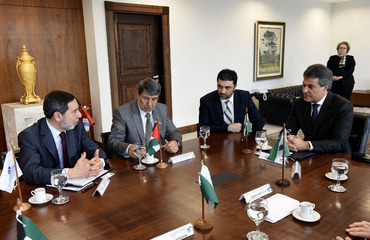
Curitiba – The state of Paraná accounts for more than 10% of Brazil’s trade with Arab countries, but it could do even more business if the list of traded goods was broader. At a meeting with Arab ambassadors in the capital Curitiba, state officials showed that 98% of exports to those countries consist of ten types of products, whereas 99% of imports are made up of ten different products.
The Arab ambassadors are on an official mission to the state as of this Thursday (13) alongside delegates from the Arab Brazilian Chamber of Commerce. Governor Beto Richa (a member of party PSDB) welcomed the diplomats and discussed the state’s economic potential, stressing fields that Paraná is regarded as excelling in, such as energy, ports and sanitation. “Paraná is doing well, it’s one of the states with the fastest-growing economies, in spite of the crisis that is going on in Brazil,” he said.
At the meeting with Richa, the Arab Chamber’s International Relations vice president Osmar Chohfi brought up the fact that trade between Brazil and Arab countries reached USD 19 billion last year, with Paraná accounting for USD 2 billion. “We can find new ways to increase that trade,” Chohfi told the governor.
Numbers from the Paraná State Development Agency show that from 2013 through mid-2016, meats made up 66% of exports from the state to Arab nations, with sugar at 18% and grains at 7%. Personnel from the Agency told the diplomats that potentially tradable products include seeds, oilseeds, paper, grains, meat products, tobacco, and electric material.
In that same time frame, 63% of imports from Arab countries to Paraná consisted of fertilizers, with mineral fuels at 24%. The state’s government believes that organic and inorganic chemicals, aluminum, electric material, vegetable- and fruit-based products could also make it into that list.
In 2015, Saudi Arabia was the only Arab country in the list of the state’s top five export destinations. It ranked fourth, after China, Argentina and the United States. In January 2015, Saudi Arabia was in 3rd, the UAE was in 16th, and Egypt was in 26th. In January of this year, Saudi Arabia, the UAE and Egypt placed 5th, 14th and 30th, in that order. Qatar was the 40th leading source of imports to Paraná in January of last year, and climbed to the 26th position in January 2016.
The data was presented by staff from the Development Agency during a meeting of the diplomats with officials from state secretariats.
The Agency’s CEO, Adalberto Netto, told the ambassadors that potential investment targets include the auto, aerospace and defense industries, technology and electronics, agribusiness, renewable energy and life sciences, real estate and infrastructure. Speaking to ANBA, the governor said Arab countries could invest in infrastructure.
Richa conveyed to the ambassadors that the state’s scenario is good due to the projects put in place since his administration began, in 2011, through incentives, the building of an investment-friendly environment, and talks with the productive sector. Paraná was the fourth biggest economy in Brazil last year, and a survey by magazine The Economist pointed it out as the country’s most competitive state. “We are strategically geographically positioned,” he asserted.
The Kuwaiti ambassador to Brasília, Ayadah Alsaidi, told the governor that he is aware of Paraná’s potential in agriculture, and said he hopes investment will be streamlined by the new political scenario in Brazil. Arab Brazilian Chamber CEO Michel Alaby remarked that Brazil must reach an agreement with the Arab countries to guarantee safe investments and end double taxation.
Governor Richa is of Lebanese descent. The dean of the Council of Arab Ambassadors in Brazil and ambassador of Palestine, Ibrahim Alzeben, said the Arab countries take pride in the working community that lives in Brazil, including people such as the governor. He acknowledged the support that Brazil has always given to the Palestinian cause, adding that he expects Brazil to be stronger and more competitive once the ongoing crisis is over.
At the meeting with state secretariats’ officials, the ambassador of Jordan, Malek Twal, expressed interest in local agriculture and livestock production, including wheat and meats. “Paraná is the biggest wheat-producing state in Brazil, and Jordan imports 97% of the wheat it consumes,” Twal said. The ambassador of Sudan, Ahmed Elsidding, was interested in the state’s fish farming, frozen bovine semen, and renewable wind and solar power.
The agenda of the meeting with secretariats’ officials also included culture, sports and education. The secretary for Culture of the state of Paraná, João Fiani, said he hopes major Arab artists will exhibit in museums in Paraná, and that the local symphonic orchestra is available to tour the Arab world. Another subject touched on by Alzeben was the possibility of having an ‘Arab world week’ in Curitiba.
Besides Netto and Fiani, also attending the meeting were the state’s secretary for Strategic Affairs Flávio Arns, the secretary for Infrastructure and Logistics José Richa Filho, the acting secretary for Science, Technology and Higher Education Décio Sperandio, the head of cabinet at the Secretariat for Sports and Tourism Valdir Smaniotto, and the director of the Rural Department at the Secretariat for Agriculture and Supply Francisco Simioni.
Also participating in the activities as delegation members were the ambassadors of Libya, Khaled Dahan, Egypt, Alaa Eldin Roushdy, Mauritania, Wagne Abdoulaye, the League of Arab States, Nacer Alem, the chargés d’affaires of the embassy of Morocco, Mohamed Boulmani, and the chargés d’affaires of the Embassy of the Republic of Tunisia, Nada Ben Naceur, plus the third-secretary to the Brazilian Foreign Ministry’s Middle East Department, Jaçanã Ribeiro.
*Translated by Gabriel Pomerancblum
