



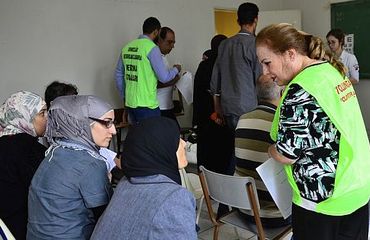
Brasília – Brazil has 8,863 refugees from 79 nationalities. According to a report released this Tuesday (10) by the National Committee for Refugees (Conare), body of the Ministry of Justice (MJ), the Syrians form the largest group of refugees in the country, with 2,298 refugees. In second comes the group from Angola with 1,420 people, followed by Colombians (1,100), Congolese (968) and Palestinians (376).
Syria’s top spot in this ranking is consequence of the country’s civil war, which drove almost 5 million people to seek refuge in other nations.
In the last five years, asylum requests in Brazil increased 2,868%, going from 966 cases in 2010 to 28,670 cases in 2015. According to the Ministry of Justice, more than 80,000 asylum requests were made in Brazil since 2010. The absolute majority (64,941) was requested by men with 80.8% of the total.
The most common age groups were all formed by working-age people. The 18 to 29 years age group had 40,369 requests (48.7% of the total), with the age group of 30 to 59 years registering 39,081 requests (47.1% of the total). The requests were sought overwhelmingly by Haitians, Senegalese, Syrians, Bengalese and Nigerians.
From 2010 to 2016, there was an increase of 127% in the total of recognized refugees in Brazil. “We hope that [this trend] is kept as a state policy, of Brazil being open to refugees of the world. We hope that there is continuity. If Brazil wants a leading role in strategic issues, it needs to contribute to the fight against this problem. That’s why amid this, the worst humanitarian crisis of the last few years, we have been taking this stance of showing the willingness to receive refugees”, said the minister of Justice, Eugênio Aragão.
From 2010 to 2015, 2014 was the year that registered the highest number of evaluations of asylum requests. In all, 2,414 requests were decided, practically the double of the previous year (1,293 in 2103). Last year, 1,667 requests were assessed.
The report shows a very significant decline in the total number of pending requests, which have fallen from 48,217 in 2014 to 25,222 in 2015. This drop, according to the ministry, is due especially from the migratory regulation of Haitians in the Brazil.
*Translated by Sérgio Kakitani

