


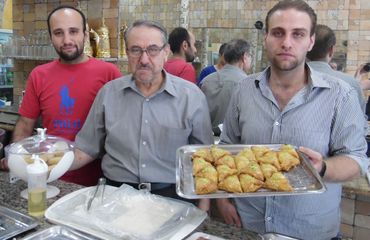
São Paulo – One of them is a doctor, the other a dentist, and the other an accountant. But in Brazil they’re entrepreneurs. Said Mourad, Mohamad Mourad and Khaldoun Mourad left Syria for São Paulo to escape the war, and found a new way to live and earn a living in cuisine. In the Pinheiros district of São Paulo, they opened Damascus, a restaurant serving meals and Arab snacks.
The first to arrive was Khaldoun, the accountant, who, unlike the others, can communicate well in Portuguese. At the same address, a year and a half ago, he opened a pastry shop offering well-known Arab recipes. The business operated that way for about a year, but after the rest of the family arrived from Syria, the income from pastry alone wasn’t enough anymore. Between Khaldoun’s and his wife’s relatives, they were 18 people total.
“My father came up and said it wasn’t enough for the whole family,” Khaldoun recalls. The father is Said, an orthopedist who lived and studied in Europe for a while. The dentist is the other son of Mr. Said’s, Mohamad. The solution was to rent out the entire property, not just the front portion where the pastry shop and kitchen were, and to convert the place, originally a home, into a restaurant. Since then, seven people from the family went back to Syria due to being unable to adapt to the local language and habits, and now Damascus is the livelihood of eleven Mourad family members.
They’re in Brazil under refugee status. Khaldoun believes doing his line of work in the country is impossible, since the accounting rules and laws are completely different, but he doesn’t consider living in Syria again, only visiting. He holds his homeland close to heart nonetheless. “I miss it a great deal,” he says. Khaldoun felt welcome by Brazilians. “We’re all equals here. Brazil is a melting pot, they all got here as immigrants,” he asserts, echoing what he heard from the locals since his arrival.
Mohamad and Said hope to ply their trades and are waiting for their diplomas to get validated. With the papers in hand, though, they will have to seek employment at practices and hospitals, since they put their money on the restaurant and cannot open practices of their own, says Khaldoun. At the Damascus, they go back and forth and even though they have employees, they will do even the most basic chores, such as replenishing the pastry and clearing out the dishes. According to the accountant, the business gets the family by.
The Syrians get some help communicating in the customers’ language from the waiter Bilel Kefi, a Brazilian-based Tunisian who speaks Portuguese.
The Damascus serves Arab delicacies such as sfiha, kibbeh, pastries such as semolina cake, sesame crackers, pistachio and nut puff pastries, and other traditional Syrian flavors. Arab coffee is also served. For lunch, there’s an Arab food buffet including 20 types of pastes, plus kibbeh, sfiha, grape leaf rolls, falafel and other staples. The recipes are courtesy of the Mourad household back in Syria.
On Saturday and Sunday, instead of the buffet, a different dish is always available, such as shish barak, a fresh curd soup, or maklube, with rice, meat and vegetables. On weekdays, the buffet sells for BRL 25, and on weekends, the dish of the day goes for BRL 30. Every day is all you can eat. The restaurant is open from 8 am to 8 pm.
Quick facts
Damascus Restaurant
Open from 8 am to 8 pm
Rua Cônego Eugênio Leite, 764 – Pinheiros – São Paulo – SP
Phone: +55 (11) 4883-0429
*Translated by Gabriel Pomerancblum
