


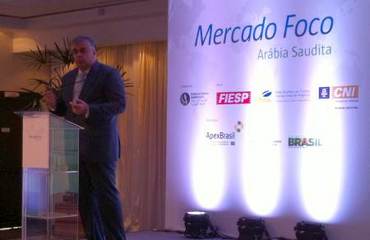
São Paulo – One of the Arab countries that offer the most opportunities for investment, and profit, is Saudi Arabia. The country is making use of the budget surplus it has amassed in the past few years to invest in infrastructure and in improving its people’s quality of life. However, the business culture differs from that of the Western world, and that calls for businessmen to be prepared. These were some of the features of the Saudi market that were outlined this Tuesday (26th) during the seminar “Focus Market Saudi Arabia,” in São Paulo. The event was promoted by the Brazilian Export and Investment Promotion Agency (Apex) in collaboration with the Arab Brazilian Chamber of Commerce, the National Confederation of Industries (CNI) and the Federation of Industries of the State of São Paulo (Fiesp).
According to the Apex Commercial and Competitive Intelligence coordinator Marcos Lélis, Saudi government projections show that the country’s Gross Domestic Product (GDP) was up 6.7% in 2012 and should keep a strong pace in the next few years. Also in 2012, the country’s primary surplus reached US$ 16.7 billion. By 2000, Saudi Arabia had the world’s 27th largest US dollar reserves. Now, at US$ 644.7 billion, it ranks 3rd, after China and Japan. Brazil has the world’s 6th largest reserves.
Lélis said the country will likely grow over the next four years, which makes it a potential export and investment target. During his address, he said Brazil is one of the leading food suppliers to the Saudi market and may increase its presence, provided that it can balance out its exports, which still vary a lot. “Our challenge lies in reducing volatility by adding value to our export portfolio and improving the standards of the goods we sell to them,” he said.
Lélis presented figures showing that although Brazil is the leading supplier of foodstuffs to the Saudis, it only ranks 32nd on the list of exporters of housing and construction products, an industry in which China has the lead. Brazil’s share in total Saudi food imports is 16%. In housing and construction, it is 0.4%.
The CEO of commercial intelligence research company Meed Insight, Edward James said the Saudi economy has tripled in size over the last ten years, and the Saudi government has spent more money since 2010 than any other country. Regarding the business environment, James cited a World Bank study showing that Saudi Arabia ranks 22nd in ease of business and 66th in transparency. In the ranking, from the non-government organization International Transparency, Brazil is placed 69th.
The Apex Market Strategy Coordinator Juarez Leal said Brazilian businessmen who wish to invest in the Saudi market will have to do what few people do: planning. Leal added that Apex is betting on the Middle East and has the tools for those who wish to operate in the region. Through the “Pró-mercado árabe” (Pro-Arab Market) program, businessmen who wish to export to the region can watch video statements from specialists, gain access to exclusive data, and get advisory from the agency. For such they must get in touch with Apex.
The agency intends to take Brazilian businessmen to Dubai for a five-day stay in October this year so they can become familiar with the local market. During that period, they will sit courses with professors and businessmen from the region. “We have devised these tools for the Middle East because we believe trade relations with the region may yield good results,” Leal told ANBA.
The manager of Apex’s business centre in the Middle East, Sidney Alves Costa said the Saudi per capita GDP as of 2007 was US$ 20,700, and is expected to reach US$ 33,500 by 2020. The country’s GDP is equivalent to 25% of the GDP of the entire Middle East, and 20% of the world’s oil reserves are in Saudi land. After the event, Costa stated that Saudi Arabia is the best investment target right now because it is a growing market that is diversifying, promoting income distribution, and increased consumption.
Difficulties
Despite all the opportunities, the lecturers at the seminar noted that it is not easy to enter the Saudi market. James said it is not easy to get a visa and women under 30 encounter more difficulties negotiating with local businessmen than men do. He also said email is not as widespread as it is in the West. “They will usually ask you to send a fax,” he said. Both Costa and Leal said the Saudis appreciate one-on-one contact, and that they like to meet the businessman they will do business with.
Two businessmen gave accounts of their experience to the audience. The owner of construction company Engeprot, Omar Hamaoui started operating in Dubai nine years ago, and has been in Saudi Arabia since 2011. Currently, the company has works underway covering 180,000 square metres, and Omar forecasts that he will build 500,000 m² a year in the country. He said major government works are carried out by three large companies. One of them, Bin Laden, employs 200,000 people.
“All the other companies are subcontracted because the main deals all go to the giants,” he said. Omar also claimed it is hard to get a visa for foreign workers, and that works must be overseen by professionals with at least three years’ experience on the Saudi market. “If a businessman fails to do that he is sure to lose money.” He added that all budget calculations must take into consideration the Ramadan, a month in which Muslims work different hours because of their daily fast, and the months of July and August, in which summer causes temperatures to rise to 50° Celsius. Despite these challenges, he says: "If it weren’t worth it, I wouldn’t have invested there.”
The accounts manager for chocolate manufacturing company Garoto, Alain Wehbe said businessmen must know how to pick the local partner that will help them enter the Saudi market, as well as invest in marketing and pay visits to clients. “Saudis like to try new things and they will try your product if it is attractively presented, and if you show that there’s something different in it. You must do that because Brazilians will hardly be able to compete, price-wise, with a company that is already established in the region.”
The Arab Brazilian Chamber CEO Michel Alaby described the Saudi market opportunities as “hard to get in but even harder to get out of,” due to the fact that once established, a company will have several clients in the country.
*Translated by Gabriel Pomerancblum
