



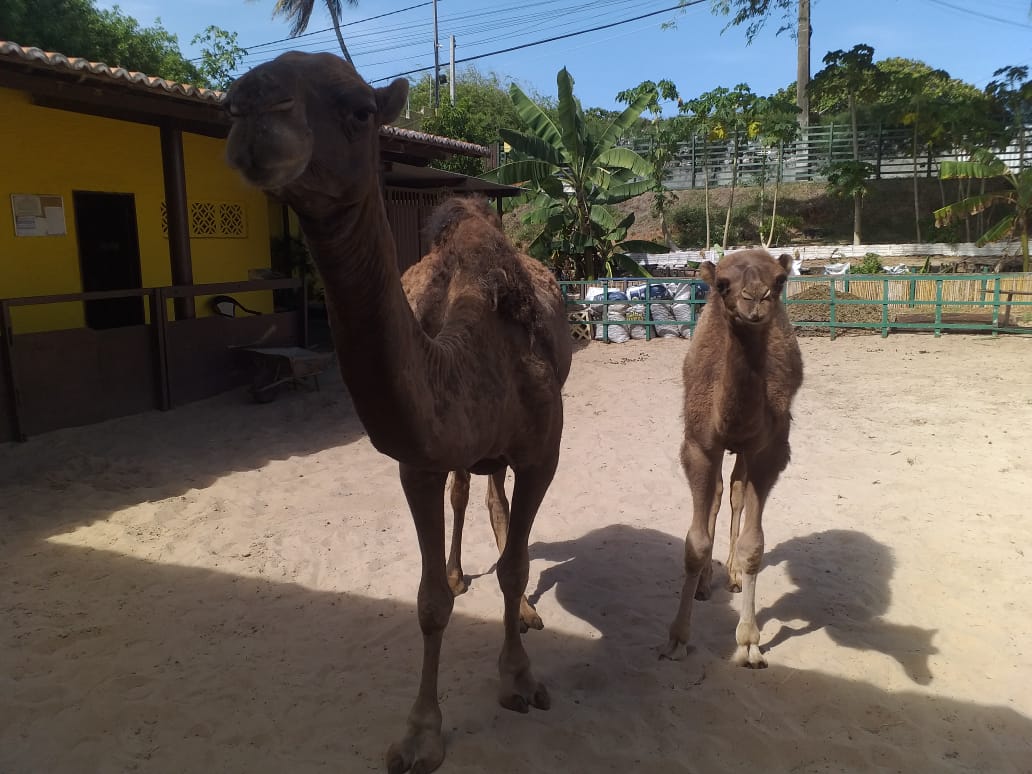
São Paulo – For 22 years, the city of Extremoz in Rio Grande do Norte, Brazil, has had dromedaries as a tourist attraction on the Genipabu dunes. Company Dromedunas Turismo offers tours with the animals, as well as educational projects on environmental and local culture issues. The idea came up from a trip to Morocco and India, where the now-deceased husband of owner Cleide Batista became fascinated with the landscape and the animals.
Due to the COVID-19 pandemic, though, Batista has discontinued the activities since March and needs help to keep the animals. “I stopped on March 21 because our activity was risky. People come from every country imaginable, and I chose to stop even before the government measures,” she explained.
The company has the collaboration of friends and supporters to keep the care and feed of its 13 dromedaries, but the amount is not enough because costs are high. The expenses include BRL 1.500 (USD 300) a week in animal feed. They also must pay the veterinarian and handler who takes care of the animals. “We always have someone in the stable where the dromedaries are kept. My daughter, who’s the manager, takes turns with me and the handler. Every day, they bathe in sun – they love it. So, it’s daily, laborious work,” Batista says.
The businesswoman explains that she couldn’t get any support from the government, so she decided to start an online fundraising. “We’re making a campaign with banners across town, and now the online crowdfunding to buy feed until December. Because we can’t afford feed. Our working capital is over. I’ve already sold eight to farm hotels, and I still have 13, and one is pregnant. We will make an ultrasound to confirm,” she explained.
The staff has been cut, and now each one works only four hours a day. The company, which started with six animals from Spain, then bought more dromedaries that started to breed in Brazil, will now leave the tourism sector. “I decided to close the tour. We will continue as an environmental school. For tourism, I will keep only the part of taking pictures (with the dromedaries), and tourists will also be allowed to use our Arab clothes,” she says.
When the pandemic started, the company was already moving from the tours around the Jenipabu dunes to the environmental education projects. Batista says that they have had other educational projects for 20 years, such as the community garden that reuses the dromedaries’ compost as fertilizer. “We already had the environmental experience, but the tours stole the spotlight. At the environment classes, we told where the animals come from, their origin, their breed. We also addressed the topic of environmental preservation area, saying that we are in one, called Jenipabu Environmental Protection Area,” she said.
The businesswoman now wants to divide the educational efforts in two fields: the region’s indigenous history and Arab history. “I’m an indigenous descendant, and I feel that I own this to my ancestors. Because not everyone gives value to them and their history, the contribution they gave. And Arab history, perhaps with a focus on Egypt. As soon as we can, we’ll revamp this place entirely,” Batista said.
Check below a video from the company’s channel where you can see the animals.
Translated by Guilherme Miranda

