



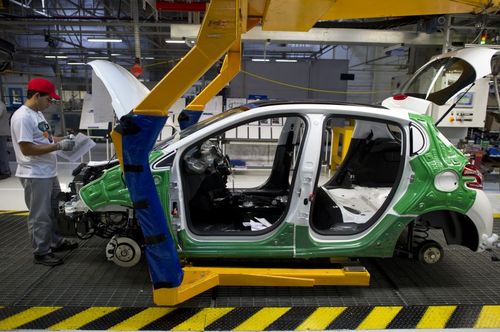
São Paulo – The Trade and Development Report 2016 released this Wednesday (21) by the United Nations Conference on Trade and Development (UNCTAD) points out that the world economy will post weak growth this year, at roughly 2.3%, and that international trade is poised to grow some 1.5%. It sees an effort from wealthy nations to drive economic growth, chiefly through the provision of credit, but warns that wages must be spurred into growth. The report advises that the economy must undergo structural changes to grow, and claims industrialization is one avenue towards sustained growth.
On introducing the report in São Paulo, contributing researcher and Campinas State University (Unicamp) Economics Institute professor Antonio Carlos Macedo Silva said Unctad believes industry in general, and the processing industry in particular, could be the primary driver of growth for world economies and international trade. “This is the industry that creates a chain reaction in the economy. Its average productivity is higher than those of other industries, like agriculture for instance. The best-case scenario would be to relocate people from low-productivity areas, such as services in general, to higher-productivity ones,” he said.
The UNCTAD paper entitled “Structural transformation for inclusive and sustained growth” also warns that the export incentives-based growth model is wearing out. UNCTAD also questions whether integrating the global supply chain at any cost is the solution for economies to grow.
According to Silva, integrating the global supply chain is desirable if a country exporting a given good can retain the value created by the deal. When the country producing and exporting the good fails to keep at least some of the profit within its borders, then the deal is not advantageous. Countries supplying higher value-added goods stand to gain more from joining this supply chain than those exporting commodities or low value-added products.
“Integrating global chains can be good or bad, because sometimes you end up compromising and producing cheap, low-value goods,” said Silva. Some of the policies the UNCTAD recommends for driving industry expansion is giving incentives to specific sectors, while avoiding choosing “champions” at any cost; coherent economic policies; and efficient paperwork procedures in connection with the private sector.
The report warns of yet another economic challenge: corporate profit is on the way up, but investment is waning. The reason is twofold, UNCTAD says – growth is slowing, and this impacts on investment; and businesses are increasingly focusing on fast profit and dividends collection.
Developing countries face the biggest challenge. UNCTAD concedes that they have suffered the blow of the 2008 crisis, but measures put in place by developed markets pose a risk to emerging ones. One of them is cheap credit, which drives rich countries to occasionally invest large sums in emerging ones and then withdraw. This creates high corporate indebtedness in developing countries and exchange rate volatility.
“The way developed countries are fueling growth is not working. They are growing via monetary policy and cheap credit instead of by increasing income and wages. This leads to investors flooding developing countries and then pulling out,” said Silva. There was a massive flow of capital into those countries from 2009 to 2013, and then investors began withdrawing in 2014.
Another challenge when it comes to the world economy is increasing families’ incomes. Over the last 30 years, consumption power has fallen markedly. One of the ways to drive wage growth is through industrialization and the implementation of minimum wage policies in countries where there aren’t any.
*Translated by Gabriel Pomerancblum
