



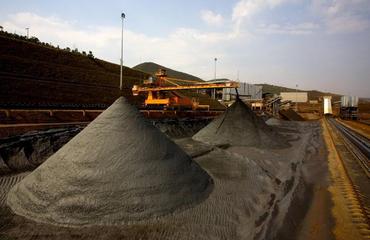
São Paulo – The Brazilian mining company Vale achieved the lowest iron ore production cost per ton in quarter three of this year, it reported this Thursday (22nd). The company loaded the product onto ships for USD 12.70 per ton. “Production-wise, we have the lowest cost in the world,” said Vale’s executive director for Finances and Investor Relations, Luciano Siani Pires. The cost had been USD 15.80 per ton in Q2 and USD 22.50 in Q3, 2014.
At a press conference, the company’s CEO Murilo Ferreira listed three reasons for the cost reduction: exchange rate fluctuation, growing production volumes and increased productivity. He stressed that the latter played a big role and was a result of greater efficiency. However, the USD 12.7 number concerns production cost only, and does not include transportation expenses. Since the company sells to China, said expenses are relevant to total costs.
Cost reduction is a necessity in the iron ore industry today, since the price of the commodity is slumping. Vale, however, celebrated the fact that ore prices edged down slightly in Q3 from Q2, going from USD 50.60 to USD 46.50 per ton. In Q3, 2014, the price was USD 68. “After a few quarters on a downward curve, we’ve enjoyed relative stability, a minor decline,” said Pires.
Several mining companies, Chinese ones included, are either trimming down production or exiting the market due to low prices. China, Ferreira said, imported ore from 59 countries back in 2011. By next year, he believes the country will be buying iron ore from 20 countries at most. The reasons for the production cost reduction that’s sweeping the industry include the dollar hike and the falling oil prices. However, according to the company, Vale is working on streamlining processes within its own value chain.
Exchange rate and revenues
Exchange rates, by the way, have played a key role in Vale’s Q3 results, with the US dollar soaring in value relative to Brazil’s real. Since the company’s debt is denominated in dollars, the company posted a loss in domestic currency. In dollars, however, the debt dropped by US$ 2.3 billion. “Despite this accounting effect, the real’s depreciation is good for the company, since we post revenue in dollars,” Ferreira asserted. He said the negative impact on the debt will be offset by revenue.
Vale saw gross operating income soar 116% from BRL 21 billion in Q3, 2014 to BRL 23.7 billion in Q3, 2015. Net loss in reais stood at BRL 3.3 billion, as against BRL 6.6 billion a year ago. Export revenues reached USD 3.3 billion in Q3 this year, and USD 5.5 billion in Q3 last year. Export numbers include sales by Samarco, a mining company in which Vale owns a 50% stake.
Gross operating income in US dollars was USD 6.6 billion, down 28.5%. Net loss in US currency was USD 2.1 billion in Q3, up 47.3% from USD 1.4 billion a year ago.
Middle East
The Middle East accounted for 3.4% of gross operating profit for Vale during the third quarter. However, the region’s share in overall business was higher in Q3 2014, at 3.9%. The numbers were USD 227 million in Q3, 2015 and USD 359 million in Q3, 2014. Vale owns a pelletizing plant in Oman, in the region. The company’s produced 2.3 million tons of ore in the country in Q3, down 3% from a year ago due to a scheduled maintenance break.
The bulk of Vale’s production gets shipped to China. The Asian country answered to 38.6% of operating profit. Asia as a whole accounted for 53.6%, followed by South America at 19.5%, Europe at 16.8% and North America at 6.2%.
Sales
The company had made divestments – asset sales – of USD 3 billion by the end of June. Although they did acknowledge that these do have an impact on cash flow, Vale executives made it clear that these sales are part of a long-term strategy designed to focus on certain activities, rather than simply for cash flow purposes.
*Translated by Gabriel Pomerancblum
