


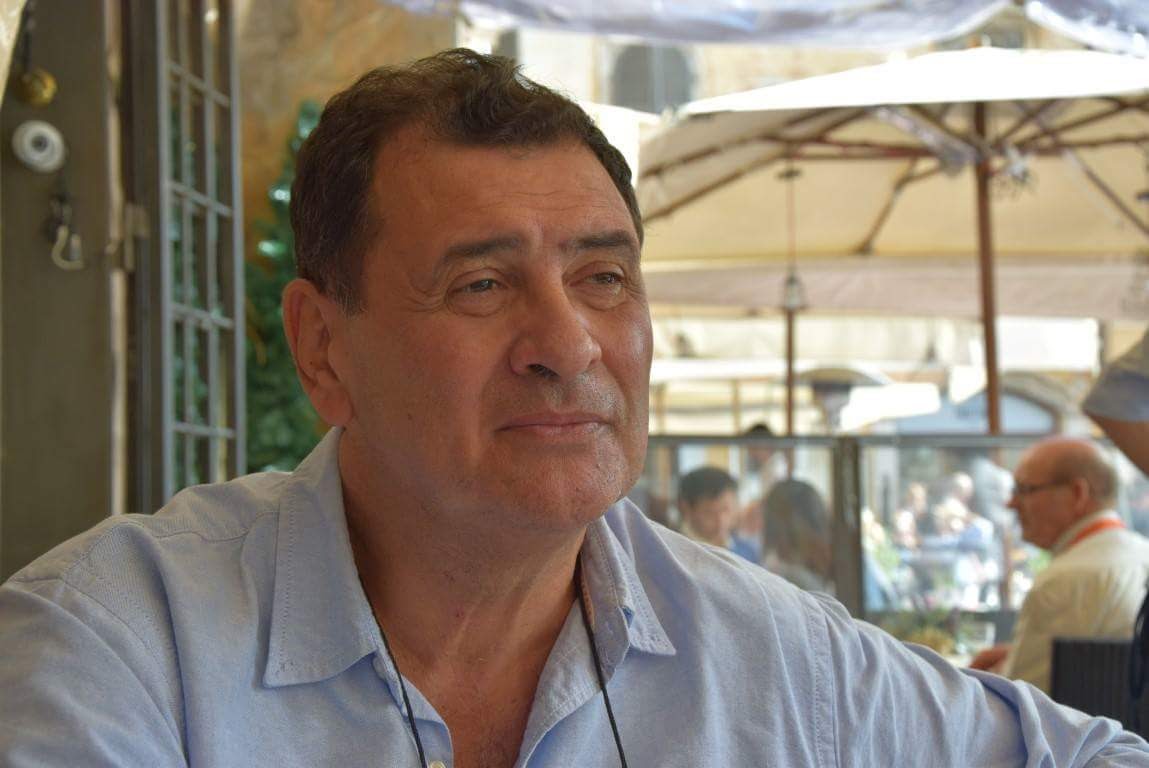
São Paulo – It was in high school that João Baptista de Medeiros Vargens, one of the leading figures in the teaching of Arabic in Brazil, first learned about the 1967 War, a conflict involving Israel and Arab countries. Then a 15-year-old from Rio de Janeiro, he identified with the Arab cause, and that moment shaped his professional choice and much of the life that followed, in a trajectory marked by experiences between West and East, extensive teaching, research, and writing.
In November 2025, Vargens released the book in which he shares with readers a taste of what it was like to have lived that journey. His greatest professional partnership was with the institution where he studied and teaches—the Arabic Studies Section of the School of Letters at the Federal University of Rio de Janeiro (UFRJ)—a bond that is clearly reflected in the book. The work also reveals that Vargens lived his teaching career guided by genuine curiosity, along with a personal drive to explore and to build.

Amassing a body of work that reflects his wide-ranging intellectual life—as a researcher and writer, as well as a man of samba—Vargens portrays in Sob a égide da Minerva – Meio século de docência na UFRJ: 1975 – 2025 [Under the aegis of Minerva – Half a century of teaching at UFRJ: 1975–2025] a vibrant career that went far beyond the classroom. It was shaped by projects abroad, by the creation of new paths to strengthen the teaching of Arabic in Brazil, and by discoveries and reflections shared through books and other endeavors. Minerva—the figure invoked in the book’s title and a symbol of UFRJ—is the goddess of wisdom.
In Sob a égide da Minerva, Vargens recounts how his Portuguese literature teacher in high school influenced him to pursue a degree in Letters. It was also during adolescence that the teacher read books by the Brazilian writer Malba Tahan, who wrote stories set in Arab lands. That period also marked his personal encounter with the Arab cause. Vargens enrolled in UFRJ’s Arabic program as part of the third cohort offered by the university, in the 1970s.
In the book, Vargens recounts his work in lexicography as a teaching assistant, at a time when compiling a dictionary meant using index cards and storing them by letter in shoeboxes. This was also a period when Vargens attended rehearsals at Portela, one of Rio de Janeiro’s greatest samba schools, and began teaching, under the authorization then granted to students to give classes in non-degree courses and private schools.
When it rained heavily, everything flooded. You had to roll your pants up to your knees, take off your shoes and socks, and muster plenty of resolve to cross the flooded railway line
João Baptista de Medeiros Vargens
“I worked the night shift and rushed out of the School of Letters in time to catch the train leaving Central do Brasil at 6:03 p.m. Sometimes I was late, and then I had to go to Leopoldina Station, the terminus of the line with the same name. From Caxias, after a hot dog and a complimentary Coke, there was one more bus to reach my destination. When it rained heavily, everything flooded. You had to roll your pants up to your knees, take off your shoes and socks, and muster plenty of resolve to cross the flooded railway line,” he recalls in the book.
The book also recounts a trip to Brasília to seek contact with Arab diplomats based in the capital and the return to Rio carrying donations: a mechanical typewriter with Arabic characters and books for the university library. Abuna—Arabic for “our father”—was how Vargens and the other students referred to Monsignor Alphonse Nagib Sabbagh, founder of the Arabic Studies Program at UFRJ and a recurring figure in the book.
His entry into the university as a teaching assistant is also recounted in the book, as is his departure for Syria to attend a specialization course in Arabic for Foreigners in Damascus. “I began my first international trip aboard a Boeing 707 aircraft operated by Royal Air Maroc. At the time, there were two weekly Rio–Casablanca flights,” he writes. He was soon joined by his then wife, Áurea de Paiva. They returned to Brazil with her pregnant, expecting their son, Omar Tárik—named in homage to Omar ibn al-Khattab, the second caliph of Islam, and Tariq ibn Ziyad, the conqueror of the Iberian Peninsula.

In the 1980s, Vargens was elected head of the Department of Oriental and Slavic Languages at the Faculty of Letters, which includes the Arabic Studies Program. From there, he continued his trajectory, advocating for the opening of a Palestinian Embassy in Brazil, giving a lecture in Morocco that already reflected his research on enslaved Muslims in Brazil, translating a book by Egyptian writer Naguib Mahfouz, spending three years teaching in Morocco, and helping to establish cooperation between Brazilian and Arab universities.
The creation of the publishing house Almádena took place in the late 2000s, together with his wife, Renata Mansour, with the aim of disseminating the academic output of the Arabic Studies Program at UFRJ’s Faculty of Letters and publishing works that had not been taken up by other publishers. Vargens also briefly recounts in the book his research into the collection of Emperor Dom Pedro II, based on the monarch’s travels to the Arab world. The Brazilian intellectual’s work was recognized by Arabs themselves on at least two occasions: when Vargens was one of the recipients of the 2011 UNESCO Sharjah Prize and when he was awarded the King Abdullah Prize in Saudi Arabia.
The book also recounts several other projects and experiences from Vargens’ career, in the personal tone characteristic of the author, offering readers engaging details from each story. The publication also includes photographs and a biobibliography that he describes as “the reverse side of the stitching,” as it presents the context in which each of his books was developed. With 164 pages, Sob a égide da Minerva, published in Portuguese, is available for purchase on the Almádena publishing house website.
Read more:
From Lebanese roots to Brazilian ballet
Translated by Guilherme Miranda
