



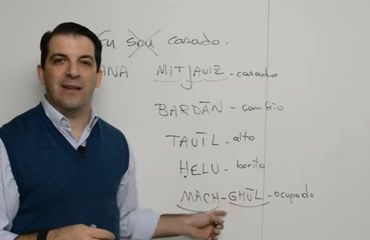
São Paulo – It’s not easy for Brazilians to be able to communicate in Arabic. The letters are different and there are sounds that don’t exist in Portuguese. As he perceived the interest of people in the language, the Arabic professor Jihad Abou Ghouche started to upload videos in the internet with classes that teach the language spoken in the Middle East and North Africa countries.
Abou Ghouche is the author of Speak Arabic in 20 lessons, launched in 2010 by publishing company Disal. Born in Rio Grande do Sul, son of Lebanese parents, Abou Ghouche lived in Lebanon from when he was 12 to 19 years old. With degrees in English Literature and Education, he currently teaches English and Arabic in Foz do Iguaçu, Paraná state.
He says that when he decided to shoot some videos for the internet, his original idea wasn’t focused on Arabic. “I uploaded some videos about English and didn’t get many views. So, I uploaded a video to talk about the book [on Arabic] and it got many views”.
The Arabic videos began to be uploaded in June. Up to now, there are 24 classes available in his channel Speak Arabic. “In three months, the videos reached 60,000 views, which for an education channel is pretty good”, he says.
In the first video, the professor teaches the personal pronouns in Arabic. An important aspect of the videos is that Brazilians don’t need to write the Arabic letters, since Abou Ghouche uses the phonetic transcription method to teach the language, that is, he uses letters of the Roman alphabet to write the words in Arabic according to how they are pronounced.
The videos available focus on the use of adjectives, how to build negative sentences, how to talk about your family, how to greet people, numbers, possessive pronouns and verbs in past tense.
“The videos follow a sequence. My idea is to reach one hundred videos, which means taking a person to the intermediate level [of the language]. In this level, the person can communicate in the present, past and future tenses and has a vocabulary of about 1,500, two thousand words”, says the professor.
Abou Ghouche teaches the classes for a conversational Lebanese Arabic, which is different from the classic Arabic used in Arab newspapers and websites, and also different from other dialects used in the other countries of the Middle East and North Africa.
In his channel, the professor also plans to upload some classes focusing on cultural themes such as, for instance, the difference between nationalities and ethnic groups in the Middle East, subjects that still confuse Brazilians. The first video on culture explains the difference between the terms Arab, Lebanese and Turkish.
According to Abou Ghouche, the classes have generated a good response, with around 40 to 50 comments per video from people asking questions about the classes. The professor says that the main challenges for Brazilians are related to the Arabic sounds that don’t exist in Portuguese. “I always say to keep calm because you won’t instantly be able to pronounce this sound”, he advises.
*Translated by Sérgio Kakitani
Watch below some of the videos of the channel Speak Arabic:

