


São Paulo – For Brazilian exporting companies, opening a unit in another country can be the next step in expanding their brands on the foreign market. The process of going international requires special attention, including market surveys and longer-term investment, but brings significant advantages to businesses that bet on this type of expansion.
The FDC Ranking of Brazilian Multinationals, an annual survey on internationalization conducted by Fundação Dom Cabral, shows that Brazilian companies in myriad industries are operating overseas. They are active in sectors such as foodstuffs, fashion, information technology, refrigeration, construction and textiles, among others.
The best-known Brazilian companies operating abroad include such behemoths as Vale, Petrobras and Embraer, but several smaller ones also do business overseas, proving that size is not a requirement when it comes to crossing the borders.
“In order for a company to go global it must have been exporting for at least three years straight to the market at hand; this is an indication that demand is steady and there is potential for growth,” says Juarez Leal, the Internationalization manager at the Brazilian Export and Investment Promotion Agency (Apex-Brasil).
Understanding one’s foreign customers and adapting one’s management are also crucial steps before opening an overseas unit. “Out of all companies going abroad, 90% need to make adaptations to the business model they use in Brazil. They need to work on visual communication, consumer preferences, inventory management etc.,” says Leal.
Three years is also the time frame required for a company to start seeing returns overseas. Thus, Leal stresses, one needs a “well-designed internationalization strategy” and an expansion plan that takes into consideration that no profits will be had for some time. “Internationalization must be factored into the business’ strategic planning,” he asserts.
And what are the advantages to opening one or more units abroad? “There are gains in innovation, market and revenues,” says Leal, who also enumerates other benefits: “You have indirect gains such as increased competitiveness. If you are only active domestically, you will never know what your international competitors are up to. The moment you go international, you become a global player. You increase your company’s talent pool, innovation comes faster and your products become more competitive. These are the main points.”
Where?
The 2014 FDC Ranking of Brazilian Multinationals provides a good overview of where Brazilian companies are working abroad. The survey covered 66 companies, of which 52 are Brazilian multinationals active in foreign countries, mostly with own units, plus 14 primarily franchise-based organizations.
Out of the companies surveyed, 75% are physically present in South America. The second region with the highest prevalence of Brazilian enterprises is North America, where 67% of all international Brazilian companies are active, mostly in the United States. In all, the Brazilian companies surveyed are present in 89 countries.
North and South America are also the regions in which most Brazilian companies choose to open their first foreign unit: these regions were chosen by 80% of the surveyed businesses to kick off their internationalization process.
According to the survey, Brazilian multinationals and franchise-based companies both tend to initiate their internationalization process in South America. “It is much easier for a Brazilian to do business in Latin America than anywhere else,” says Leal. According to the Apex manager, language and consumer behaviour are the main factors in choosing the region.
Fundação Dom Cabral’s ranking shows that most of the surveyed companies opted for the United States, and that out of the 13 countries with the most Brazilian companies, eight are in South America. Outside of the Americas, the country with the most Brazilian enterprises is China. European highlights include Portugal and the United Kingdom.
In the Middle East and North Africa, Brazilian companies are active in Egypt, Libya, Morocco, Tunisia, Saudi Arabia, Qatar, the United Arab Emirates, Kuwait, Lebanon and Oman. Leal warns that opening a unit in an Arab country warrants much greater caution. “They [the Arabs] have the best of the best available to them. It is a highly sophisticated market,” he claims.
In practice
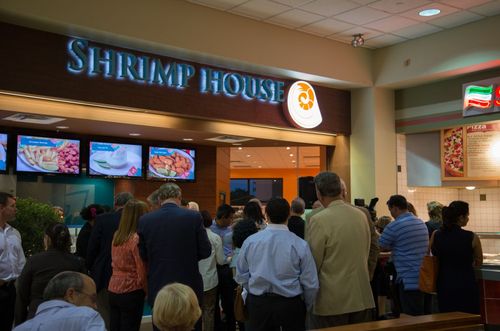
Seafood restaurant Vivenda do Camarão opened its first store abroad seven years ago in Paraguay. The initiative came from a Brazilian who was a fan of the brand and decided to bring it to the Paraguayan city in which he lived, Pedro Juan Caballero.
It wasn’t until 2013, however, that the brand truly went full steam in its international expansion by opening its first store in the United States. Rodrigo Perri, the director of Vivenda do Camarão, explains that the brand wanted a piece of the American action, and associated with a strong shopping mall conglomerate in order to enter the scene.
“There is nothing like it in the food courts of shopping malls. Seafood is widely consumed in the United States, but only on street stores,” Perri explains.
To learn about the tastes of American consumers, the brand held product tastings and did research into flavours and textures before opening its first store. Nevertheless, after the inauguration it still had to make modifications, such as adapting spices and adding new dishes to the menu.
“No matter how much research you do, you will make mistakes and you will have to adapt on the fly if you want customers to keep coming back to your store,” Perri warns.
In November this year, Vivenda is set to inaugurate its sixth United States store, and two others are in the pipeline for 2015. According to Perri, the company plans on having 33 stores in the USA by 2016, all in the Miami, Florida area.
All Vivenda units in the USA are own stores, and franchises should only be available in the country after 2016. The investment required for opening one store in America ranges from US$ 550,000 to US$ 600,000.
At Shrimp House – Vivenda do Camarão’s American moniker –, much of the food is precooked in Brazil, at the company’s food processing centre. The dishes are shipped to the United States and all the employees have to do is heat up. Only ingredients such as rice, lettuce and potatoes are purchased and cooked locally. “This way, I can guarantee our flavour and quality in Brazil and internationally,” says Perri.
The director believes one of the main obstacles in going international for Brazilian companies is the lack of consumer awareness of their brands.
“You have to start from scratch. You need to work on your brand to make it known. You have to be very careful in promoting your brand so it gets recognized the way you want it to,” he admonishes.
He also stresses that all this work pays off: “A brand’s simple presence on the United States market adds value to it. It becomes a multinational brand, and consumers recognize it,” he says.
Vivenda do Camarão is at an advanced stage of talks with a Portuguese conglomerate looking to bring the brand to Portugal, Spain, Germany and Britain. The company is also interested in expanding in Paraguay and opening stores in Chile, Colombia and Peru.
Arab market
Puket, a women’s socks and underwear brand for children and young adults, opened its first foreign store in 2009, in Venezuela, through a franchisee’s initiative. Then, in 2014, the company decided to really invest in the foreign market and opened a store in Panama, looking to broaden its horizons.
“We have contracts signed in Angola, South Korea and Bolivia for next year, and right now I am in Saudi Arabia, finishing a contract with a local franchiser. Next month, we are also opening Puket ‘shop-in-shops’ in El Salvador and Guatemala,” Puket’s foreign markets manager Joana Wickmann told ANBA by email.
According to Wickmann, Puket’s foreign strategy consists of working with local retailers that operate with other brands, which the company believes makes the operation safer, because its clients know the market and its inner workings.
The cost of opening a Puket store abroad is approximately US$ 150,000. In the Middle East alone, the manager reveals, the brand is on the verge of signing contracts to open stores in the United Arab Emirates, Saudi Arabia, Oman, Qatar, Kuwait and Lebanon. Next year, Puket will do prospecting in the Japanese market.
Wickmann explains that the international expansion required a few adaptations to the brand’s products. “The project is still at an early stage. By next year, however, we will open stores in Arab countries, therefore we will not be able to send them items with pig prints, which are fairly widespread in our collections, due to cultural and religious issues. In South Korea, we will need to work on our winter collection, because the country is much colder than Brazil,” she says.
According to the manager, Puket has a five-year foreign expansion plan.
*Translated by Gabriel Pomerancblum

