


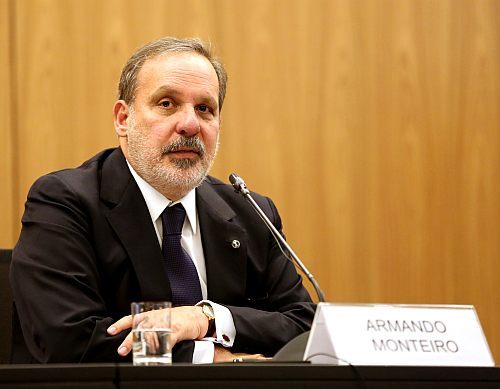
São Paulo – The Brazilian Minister of Development, Industry and Foreign Trade, Armando Monteiro Neto, is betting on a national export-oriented policy and on microeconomic reforms to make the productive sector more competitive, as the government is adopting fiscal and monetary adjustment measures, such as raising interest rates and taxes, in a bid to curb inflation and the public deficit.
“The [export-oriented] policy will encompass measures designed to overcome hurdles relating to financing, export-related guarantees and tax breaks, and facilitation of trade,” the minister told ANBA by email. “The gap between the size of our economy and our exports is very worrisome,” he added. Monteiro stressed that Brazil’s is the seventh largest economy in the world, but ranks a meager 22nd in the list of exporting countries.
As pertains to markets, he say the government plans on aiming for traditional partners – such as the Mercosur and other South American countries, the United States, and China – so as not to lose space, but also on working on destinations such as the Arab world. “The Arab countries are long-standing partners of Brazil, and we intend to uphold this status,” said Monteiro, who took office in early January. Work will also be done on broadening trade agreements.
As potential “low fiscal impact” microeconomic measures, he mentioned the streamlining and red tape reduction in tax- and foreign trade-related procedures. Read the interview below, which has been lightly edited for clarity and length:
ANBA – What will your priorities be at the helm of the Brazilian Ministry of Development, Industry and Foreign Trade?
Armando Monteiro Neto – Our greatest challenge at this time is building an economic and institutional environment that is conducive to greater productivity, while cutting down systemic costs and improving our international competitiveness. This is why we are working on a set of measures that will allow us to provide a better working environment to the productive sector. We will also elevate foreign trade to a new status, with a national export plan that should be launched as early as March.
You have said you intend to launch an export stimulus package. What measures will be taken to this end? Can foreign sales be made to grow at a time when the world economy is still fragile?
The policy will include measures designed to overcome impediments that relate to financing, export guarantees and tax burden reduction, and trade facilitation. We will prioritize Portal Único do Comércio Exterior (Single Foreign Trade Portal), a tool for speeding up, simplifying and giving transparency to import/export procedures. The gap between the size of our economy and our exports is very worrisome.
We are the world’s 7th largest GDP, yet we only rank 22nd on the list of leading exporting countries, with a 1.2% share of total exports worldwide. We also want to invest, in tandem with the Ministry of External Relations, on broadening our trade agreeements.
Does the government plan on increasing trade promotion? In what way?
Yes, that is one of the actions in our plans to increase exports from Brazil. In addition to working for broader trade agreements, we will step up our efforts in promoting Brazilian companies, and employ intelligence tools in order to find new business opportunities on the international market. The Brazilian Export and Investment Promotion Agency (Apex-Brasil), which is tied to the Brazilian Ministry of Development, Industry and Foreign Trade, will be crucial in doing this work.
Which are the priority markets for the government?
At this initial stage in our national export plan, the idea is to go for strategic partners such as the Mercosur, United States, China and South American countries, while not losing sight of other international markets, so as to diversify our export targets, which I also deem a priority.
During the administration of former president Lula, the Arab countries were one of the priorities, but for the past few years, the number of actions targeting that market has gone down. Do you intend to resume work in this sense? How so?
Initially, we want to focus our actions on markets we believe there is reason to do emergency work on, either because we are losing share or, in the case of the US, because it is the world’s premier consumer market, and we can still increase our export to them, especially now that we are witnessing a rebound of American economy.
As for the Arab countries, although the number of promotional actions has gone down, these markets remain crucial to Brazil’s trade policy. The Arab countries are long-standing trade partners of Brazil, and we intend to uphold this status.
For the past few years, the government has given incentives to certain segments of industry, looking to stimulate the economy (autos, major appliances etc.). Does this policy still stand or will it be changed? What will the industrial policy like in your term?
A distinction must be made between temporary tax breaks due to specific reasons, such as the lowering of the tax on industrial goods (IPI) or the tax on major appliances, and an industrial policy per se. These were actions taken with a short- to medium-term goal in mind, namely fuelling domestic consumption. Whether they will be used again will hinge on future decisions by the government. Regarding the industrial policy, Plano Brasil Maior (the Larger Brazil Plan), launched during the first term of president Dilma Rousseff, saw the implementation of an important set of structural initiatives.
At this time, the Brazilian Ministry of Development, Industry and Foreign Trade is working on building a positive, comprehensive, and structure-oriented agenda designed to make Brazilian industry more competitive. This policy will be articulated and underpinned by the national export plan.
Can one reconcile industry incentives and the need for increasing tax collection? It is worth noting that tax increases have already been announced.
The lack of competitiveness of the Brazilian industry cannot be solved simply via tax benefits. We can move forward through a microeconomic reform agenda that will lower the cost of legal obligations and improve the working environment for companies. Simpler, less paperwork-heavy tax and foreign trade processes and procedures will drive up productivity and improve legal security. Besides, the prospect of improvement of the concession system for infrastructure and logistics will benefit the entire industry.
How does one go about encouraging industrial production in a scenario of rising interest rates?
Firstly, it must be stressed that the monetary and fiscal adjustment measures are paramount in seeking to re-establish macroeconomic equilibrium, increasing the confidence of economic agents and rendering economic fundamentals more predictable and stable. To that end, I believe strict measures must be well communicated, while also working and giving out signals so investment will rebound. Such measures that could be put to work include the national export plan, which is being outlined at this time; and a set of low-fiscal impact microeconomic reform measures, ones that will improve and harmonize the tax environment. As I said before, these actions ultimately cut costs for the productive sector and lead to productivity gains.
*Translated by Gabriel Pomerancblum

