


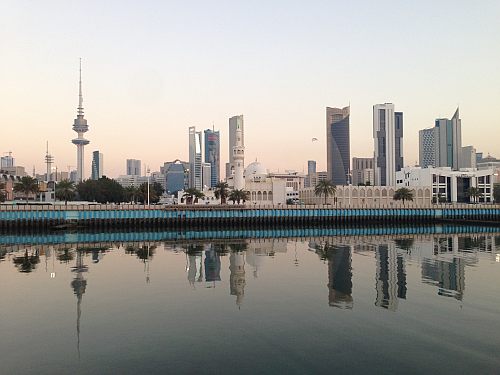
Kuwait City – Kuwait is a small country, not even 18,000 square kilometers in area, smaller than any Brazilian state, with a population of about 3.8 million people, less than a third of the city of São Paulo; but the country has almost 10% of the world’s oil reserves, with production greater than 3 million barrels per day. Consequently, Kuwait has a lot of money to invest, particularly abroad.
“Kuwaitis like investing abroad, the country is small so we seek opportunities outside,” said the deputy director-general of the Kuwait Chamber of Commerce and Industry, Hamad Al Omar, in an interview with ANBA.
This is confirmed by statistics. According to the United Nations Conference on Trade and Development (UNCTAD), Kuwait makes a lot more foreign direct investments (FDI) than it receives. In 2012, Kuwaiti investments abroad reached US$ 7.562 billion, while FDI coming into the Gulf country added up to US$ 1.851 billion. This phenomenon is repeated every year.
The main agent for investments abroad is the Kuwait Investment Authority (KIA), one of the oldest sovereign wealth funds in the world and the first in the region, with origins in the 1950s and assets evaluated at US$ 386 billion, according to the Sovereign Wealth Fund Institute website. There are also significant investments from other state-owned companies and private parties.
Some examples include KIA, which has a 7.6% share of the German carmaker Daimler, owner of the Mercedes-Benz brand; Investment Dar with controlling stake of British Aston Martin; and Kuwaiti logistics company Agility present in Brazil since 2010, when it acquired Itatrans (read more about Kuwaiti relations with Brazil by clicking on the link at the end of the page).
The Arab country is also highly interested in Asia, in countries such as Japan, China and Korea, where it exports good part of the oil it produces. “We have great investments in these markets, in banks, for example,” said the Economy editor at the Kuwait News Agency (Kuna), Fawaz Karami.
Despite all investments in assets abroad, Kuwait’s foreign accounts are in order. With oil production and exports, the country achieves record surpluses in foreign trade, according to the latest report by the International Monetary Fund (IMF) on the local economy. Karami adds that this performance has been going on for 14 consecutive years.
There is, however, another factor behind Kuwaitis’ tastes for investments abroad. As well as being small and arid, the country is also vulnerable, as it is surrounded by powerful neighbors: Saudi Arabia, Iraq and Iran. The Iraqi invasion in 1990 is still fresh for the local population, although officially relations between the two countries have been reestablished. The fear of losing everything to a new invader is another incentive for investing abroad.
According to the International Relations professor at the American University of Kuwait, George Irani, the memory of what happened over two decades ago, and the current dispute between Saudi Arabia and Iran, means that local society is bit paranoid. “If it weren’t for the United States, Kuwait would have been lost in a sandwich between Iran and Saudi Arabia,” he stated.
The USA and Kuwait are long-time allies. The North American country kicked out Saddam Hussein’s troops in the beginning of the 1990s and still maintain military presence in the country. There is, however, a general feeling that the Americans are slowly drawing away from the region’s problems, due either to the weariness since the invasion of Iraq in 2003, or to the possibility that they will become self sufficient in oil.
In this sense, the Gulf nations are strengthening their relations with other partners, particularly in Asia, which already accounts for a considerable share of the region’s oil exports, and is a great product and workforce supplier. In Kuwait, natives represent less than one third of the total population, the remainder is formed by expatriates, particularly Asian workers.
Internal market
The high levels of investments in foreign markets does not mean that the local economy is not doing well, much to the contrary. Last year the country’s growth slowed down, to 0.8%, but after a growth by 6.2% in 2012, according to the IMF. This year, the Gross Domestic Product (GDP) in Kuwait is expected to increase by 2.6%.
Inflation registered at around 3% in 2013, almost half of Brazilian levels. The benchmark interest rate is at 2% per year, lowest levels in history. The IMF forecasts an expansion of non-oil related activities for this year and the next, as there are possibilities of an increase in investments in local infrastructure.
For a country to have sustainable growth it has to have a diversified economy. According to Karami, the government wishes to transform Kuwait into a financial hub by 2035 and is implementing a plan that foresees investments of US$ 100 billion in infrastructure and the oil chain every five years. The first five-year period ends in February, but according to him, only 47% of the anticipated sum was invested. “It is the first time we have a plan of this sort,” he explained.
One of the problems Kuwait faces when applying the investment budget is the dispute between the government, headed by the Al-Sabah family, of emir Sabah Al-Ahmad Al-Jaber Al-Sabah, and Parliament. The two powers are constantly fighting, which leads to periods of political and investment paralysis.
At the end of the first five-year period, there are expectations for a new plan with the same budget for the next five years. The focus is on transportation and logistics works, with prospects for concessions, public-private partnerships, and even privatizations.
Strengthening the private sector is also a priority. Kuwait wishes a greater share of the riches produced domestically to remain in the country and, at the same time, increase the amount of foreign investments coming in. As for the oil sector, the country has reached the peak of it’s production capacity and, to expand it, it must invest in exploration.
For professor George Irani, Kuwait “lives on borrowed time”, that is, it will not be able to live forever from oil revenues, without charging significant taxes and developing other strong economic activities. “You see great hotels here, but there is no tourism,” he said.
In fact, the great hotel chains are present in the country, but you don’t see the type of promotion that takes thousands of foreigners to the other emirates in the region, such as Dubai, Abu Dhabi and Qatar. To the contrary, Kuwait is a great supplier of tourists.
The journalist travelled as a guest of the Kuwait government.
*Translated by Silvia Lindsey

