


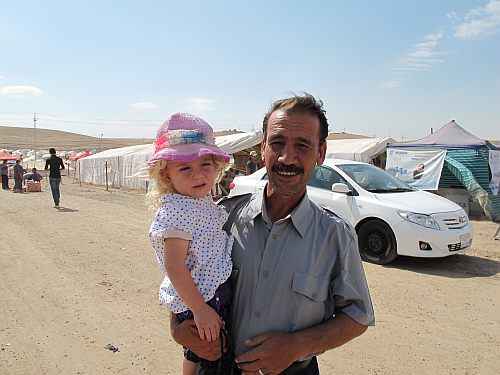
Erbil, Iraq – In the past decade, thousands of Iraqis eloped to Syria as a result of the United States’ invasion and the war that ensued. Now, the flow has been reversed as thousands of Syrians seek asylum in Iraq to escape the civil conflict that plagues their homeland.
Such is the case of Mohammed Ali Azo, Aziza Hassan Yunes and their family, originally from Hasaka, in Northeast Syria, near the Iraqi border. They are now living in the Kawergosk refugee camp, set in a rural area near Erbil, the capital of Kurdistan, in Northern Iraq. It is one of many settlements arranged in the region by the United Nations High Commissioner for Refugees (UNHCR).
“Before the conflict we had everything, a house, land, a good life, thank God, but then utilities disappeared one by one, power, water, medical treatment,” Aziza told the ANBA envoy, who visited the camp on September 24th. She speaks Kurdish, and the UNHCR public information associate in the region, Yousif Mahmood, acted as her interpreter.
The victim of a stroke, Mohammed was rendered unable to obtain his medication. Besides, security has deteriorated in the Kurdish area of Syria. “There were a lot of problems, there was no safety, there were kidnappings, murders, demands for ransom, the situation became miserable,” she said.
Their son, daughter-in-law, and grandchildren were already on the Iraqi side of the border for five months, and the couple of farmers decided to leave home too. “We could no longer stay there,” said Aziza. The two crossed the border on August 18th.
According to Mahmood, the government of the autonomous region of Kurdistan decided to open the borders with Syria on August 15th, and they remained open up until September 21st, when elections took place in the three Northern Iraq provinces: Dohuk, by the Syrian border, Sulaymaniyah, by the Iranian border, and Erbil.
“Most refugees [in the region] are Kurds from Syria,” Mahmood said. “Apart from the situation in Syria [as a whole], there were also clashes between local Kurds, so people fled in flocks and they are still coming,” he added.
There are approximately 220,000 refugees in Iraqi Kurdistan; of these, an estimated 60,000 have arrived after August 15th. Not all go to camps; some stay at relatives’ homes, for instance.
Aziza said she and her husband crossed the border alongside “thousands of people” and were received on the Iraqi side by the “peshmerga,” as the Kurd militia is known. The peshmerga have defended the Kurds for nearly a century now, and is now mostly integrated with the official security forces of the Kurdistan Regional Government, aka the Zervani. The UNHCR was also there to receive them.
“They put us on a bus and distributed us [to different camps],” said Aziza. Her group arrived in Kawergosk late in the evening, and the camp was still in the process of being set up, but in the morning that same day they were in their tent.
The tents supplied by the UNHCR were set up by Zervani soldiers in an area ceded by the local government. The government is also responsible for the camp’s direct administration and security. The tract of land is surrounded by hills on which bunkers have been built, with armed soldiers inside.
Pressure
“The camps were set up overnight, we could not have done [this job] without government aid. The response has been great, both from the government and the Kurdish people,” Mahmood said. He claimed, however, that such migratory influx in a short period of time gives rise to social and economic pressure. “Despite the positive response and the donation campaigns, this is a challenge to society and the government, and there is pressure on basic services,” he said.
The UNHCR associate said the refugee issue in the region gets less attention that the outflow of Syrians to Lebanon, Turkey and Jordan. “Now we are calling for more international community support to address this issue,” he said.
Sitting in front of their tent, by their relatives and friends, Aziza and Mohammed revealed, for instance, that they have yet to find the medication he needs. “Still, comparing this to what happens in Syria, we have a life now; it’s hard, we worry about our relatives who have stayed back in that dangerous place, but we are happy, we are well, we have a tent, electric power, gas, food. We have nothing to complain about,” she said.
The refugees get support from other UN agencies and various government organizations. The United Nations Children’s Fund (Unicef), for instance, helps with education; the World Food Programme (WFP) helps with the food; the World Health Organization (WHO) and the NGO Doctors Without Borders help with medical issues; the International Organization for Migration (IOM) helps with migratory flows; and so on and so forth.
The organizations also count on aid from local and international voluntary workers. Such is the case of Brazil’s Marcelo Viana, the marketing director at Iridium Solutions, an information technology company based in Erbil. He said he helped a local NGO distribute small stoves to the families in a camp near the capital of Kurdistan. “Voluntary work is worthwhile; it made me happy to be able to help in some way,” he said.
Viana added that the company he works for has a project of setting up a computer laboratory in the Domiz camp, the largest in the region, with approximately 45,000 people, in the Dohuk province. “Before [the camps were set up], many of the refugees were on the streets begging for change,” he said.
According to Mahmood, the Syrians are free to come and go, and many are getting jobs in the cities. “There is a demand for labour here and Syrians can help fill the gap,” he said. The Iraqi Kurdistan enjoys stability, safety and a healthy economy, unlike other areas of the country.
Economic activity also takes place within the camps. In Kawergosk, several refugees buy goods in the city and resell them in the camp, in makeshift shops under tents.
The area
The camp occupies a vast area, covered by white tents made beige by the sand, which piles up and seems constantly in suspension under the hot, dry weather. The tents have air conditioning. It may seem like a luxury, but it is hard to fathom someone surviving under a tarpaulin in the scorching Iraqi sun. The area is occupied by approximately 14,000 poor people.
At first sight, the site is reminiscent of the encampments of Brazil’s Landless Movement (Movimento dos Sem Terra – MST), or a set of improvised shelters for homeless people struck by a natural disaster. But it isn’t, and one soon realizes that the tents are arranged into streets, boulevards, and small blocks that harbour members of one same family. There are prefab bathrooms and water tanks scattered across the entire area. Some places still reek nonetheless.
There is a strikingly high number of children running around, playing with kites or anything they put their hands on, and there are also many women. As the ANBA envoy sat in front of Aziza and Mohammed’s tent, their grandchildren were also running to and fro, curious about the visitors.
On one of the hills siding the camp, someone arranged stones into the shape of a heart and wrote “Qamshlih” (pronounced “Kamshlaw”), the Syrian city from which many of the refugees came. “If the situation in Syria improves, we will go back; we have our home there, but we don’t know what will happen,” Aziza said.
When the time came to leave, there was a moment of tension. While taking pictures at the entrance to the camp, the ANBA envoy was approached by three soldiers. One of them tried to take away the mobile phone and camera, as the three of them spoke in Kurdish. Despite the envoy’s unfamiliarity with the language, it became clear that they did not want to be photographed. They had not, and on ascertaining they were not in the pictures, they bid farewell.
*Translated by Gabriel Pomerancblum

