


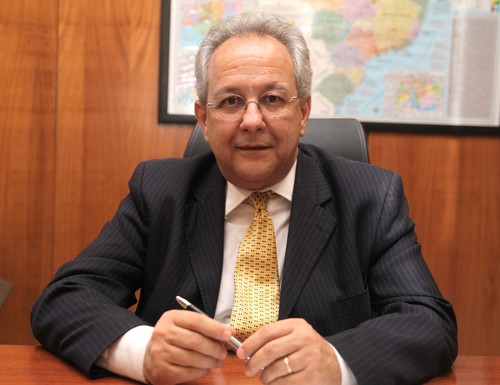
São Paulo – The new International Relations Secretary at the Ministry of Agriculture, Marcelo Junqueira Ferraz, was inaugurated on February 2nd, taking over from Célio Porto. In an email interview to ANBA, he states that infrastructure works under development in the country should make agribusiness more competitive abroad and that one of the ministry’s goals is to add value to agricultural products. Regarding the Arab countries, Ferraz says trade has grown fivefold since the completion of the first Summit of South American-Arab Countries (ASPA) in 2005 in Brasilia. Even so, he says, there is room to expand the business relationship with the Middle East and North Africa even further.
The former superintendent of the National Supply Company (Conab) in Belo Horizonte and Rio de Janeiro, and former director of the Department of International Agribusiness Promotion at the Ministry of Agriculture, Ferraz says that one of his priorities ahead of the International Relations Department will be to persuade countries that do not recognize the sanitary status of Brazilian beef to return to buying the product.
In December 2012, the government revealed that a cow in the state of Paraná had died bearing the agent that causes "mad cow disease", albeit without developing the disease. Several countries embargoed imports of Brazilian beef, including Egypt and Saudi Arabia. Many have already suspended the embargo, and the World Organization for Animal Health (OIE) has recognized the status of "negligible risk" for Brazilian beef. "Hundreds of partners, many with health services of world renown for their rigour, currently import Brazilian beef, showing recognition of our sanitary status. We see no reason for other markets to deny or delay this recognition," he says. Read the main stretches of the interview below:
ANBA – Agricultural products lead Brazil’s export basket and are those in which the country is highly competitive abroad. Is it still possible to expand this market? How?
Marcelo Junqueira Ferraz – Due to the competence and dedication of Brazilian farmers, the country succeeded, in the second half of the 20th century, to gain a privileged position in the world agricultural product market. In the last decade, the volume and diversity of products sold increased significantly and the value of agribusiness exports grew over 210%. Nowadays, it is practically impossible to mention a country in which there are no Brazilian products. Although the achievements to date make us very proud, we believe that the potential of Brazilian agriculture grants us space to pursue more.
Internally, increasing logistics efficiency should allow fuller use of the potential of the Brazilian countryside, with products reaching the ports and foreign markets more easily. Externally, the Ministry of Agriculture is working closely with foreign authorities to open new markets. In this respect, we will extend the dialogue with our partners on all continents in pursuit of elimination of technical and commercial constraints that, occasionally, unfairly exclude Brazilian products from some markets.
Are there any urgent problems you plan to solve or is there any challenge you want to "attack" now?
One of the challenges needing immediate attention is intensification of dialogue with some countries that insist on not recognizing the World Organisation for Animal Health (OIE) decision that ranks Brazil as a country with very low risk of Bovine Spongiform Encephalopathy (BSE, which causes the so-called ‘mad cow disease’). Hundreds of partners, many with health services of world renown for their rigour, currently import Brazilian beef, showing recognition of our sanitary status. We see no reason for other markets to deny or delay this recognition.
Can we add value to our products, expand sales beyond commodities and get even better results with the Brazilian agricultural sector?
Adding value to Brazilian products from the countryside is a constant concern of the Ministry of Agriculture. I do not believe there is opposition between being a major exporter of commodities and being a country that can add value to the products it sells to the rest of the world. The export of commodities will always be part of Brazilian exports since the efficiency of the country’s agricultural products allows global penetration at competitive prices. Additionally, we are concerned about adding value to the items we export. Specific actions are being undertaken in several sectors, such as cane spirit and coffee. The Ministry of Agriculture works, along with other government and private sector partner companies to internationalise Brazilian food and drinks, allowing more value to be added to export products, generating more jobs and more foreign currency and promoting Brazilian products and lifestyle abroad.
What is currently the main challenge to Brazilian agricultural product exports and how can they be overcome?
I believe we are beginning the process of overcoming one of the major challenges to Brazilian international trade. The geographic change in Brazilian agriculture that has taken place in recent decades was not accompanied by corresponding development of technical systems related to the sector. Over the next few years, several infrastructure projects will increase logistics efficiency for the transport of Brazilian agribusiness – integrating road, rail and inland waterway transport.
For producers in the Brazilian Midwest, this will mean reducing the transport distance by around one thousand kilometres. The transport system will change significantly, thus alleviating the ports of the South, turning the product to the terminals in the North. In addition, it will also be possible to take advantage of the upcoming expansion of Panama Canal, resulting in savings of about 20% in the freight cost and in four days travel-time in shipments of grain bound for Asian markets, large Brazilian buyers.
The main buyers from Brazil are China, the United States and the European Union. Does the ministry aim to increase sales to these destinations or to find other clients?
Brazil believes it is possible to conquer new space without neglecting traditional partners. Thus, we operate both in large established markets and in emerging new players. Over the last decade, we managed to decentralize our export flow, while increasing values exported to the major buyers of Brazilian agribusiness products.
In 2002, exports to China, the United States and the European Union accounted for 60% of agribusiness sales. In 2012, despite the unprecedented growth in sales to China, the combined share of these three markets was only 49%. These numbers are the result of our increased efforts in seeking to diversify markets for Brazilian agriculture.
In this context, can the countries of the Middle East and North Africa be "targeted" in the Brazilian search for strong customers outside the US, China and the EU?
Our partners in the Middle East and North Africa are fundamental in this search for new markets for Brazilian agricultural products. The recent closer ties between South America and the countries of the region, symbolised by the Summit of South American-Arab Countries, has already yielded significant fruit in good acceptance of Brazilian products in the region, which is reflected in trade results. In the last decade, agricultural trade between Brazil and the Middle Eastern countries has grown almost fivefold. Between Brazil and the Maghreb region (Algeria, Tunisia, Mauritania, Libya and Morocco), the flow has increased by over 700%. Although the figures are gratifying, we believe that due to the complementarity between the economies and the good business relationships we wage, the potential for trade is even greater.
*Translated by Mark Ament
