


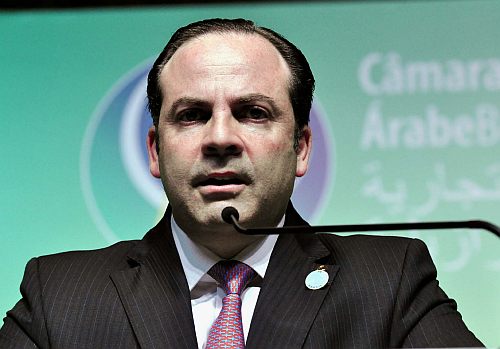
São Paulo – The Arab Brazilian Chamber of Commerce president, Marcelo Nabih Sallum, has said in an interview for ANBA’s 10th anniversary commemorative edition that there are still “huge opportunities” to be tapped into in relations between Brazil and the Middle East and North Africa countries. “There is a lot of work ahead of us,” said the executive, mentioning trade, tourism, financial services and investment, infrastructure and healthcare.
He said that “sustaining lasting bilateral relations” requires knowledge of each country’s needs, as well as overcoming fiscal, logistical, sanitary and cultural obstacles.
With regard to spreading said knowledge, Sallum noted that ANBA plays “a key role” and that it is “one of the most up-to-date, competent sources of information on Brazil and the 22 Arab countries.” He mentioned that a study presented by the Arab Brazilian Chamber at the beginning of the first term in office of Brazil’s former president Luiz Inácio Lula da Silva, in 2003, laid the foundation for a policy to develop closer economic ties between the two regions. Read the interview below:
ANBA – Bilateral trade between Brazil and the Arab countries has increased significantly in the past ten years, from US$ 4.9 billion in 2002 to US$ 26 billion in 2012. In your opinion, which factors have led to this growth?
Marcelo Nabih Sallum – The factors were manifold, but I would say the main one was Brazil taking a greater interest in the Arab market, a region comprising 22 countries with a population of over 350 million.
Over that same period, diplomatic ties were also strengthened, three editions of the Summit of South American-Arab Countries (Aspa) took place, new Arab embassies were established in Brazil and Brazilian embassies were established in Arab countries, and several authorities paid visits, among other activities. Moreover, direct flights were launched connecting the Middle East and Brazil, and initiatives were implemented in other areas, such as culture. Which do you believe were the highlight events in Brazil’s relations with the Arab world in the past 10 years?
From 2003 to 2010, the Brazilian Presidency paid visits to Qatar, Saudi Arabia, Egypt, United Arab Emirates, Jordan, Lebanon, Palestine, Syria, Libya, and Algeria. A total of 10 countries were visited, and the [then] president [Luiz Inácio Lula da Silva] travelled to some of them more than once.
It is important to note that some of these countries had never been visited by a Brazilian head of state, while others had been last visited by the Emperor D. Pedro II [in the 19th century].
These visits were key to strengthening ties between Brazil and the Arab world, creating opportunities for Brazilian exporters and infrastructure developers.
Another highlight event was the setting up of Aspa, a mechanism for bringing the two regions together composed of 34 member countries. Many things have been accomplished following Aspa’s inception, including technical cooperation for reducing [drought] impacts and fighting desertification and soil degradation processes, and the creation of the South America-Arab Countries Library and Research Centre (Bibliaspa), which is carrying out several cultural projects.
Another crucial initiative was the setting up of a Business Centre by Apex-Brazil (the Brazilian Export and Investment Promotion Agency) in the city of Dubai.
What was the Arab Brazilian Chamber’s contribution to this process?
At the beginning of Lula’s term, the Arab Brazilian Chamber presented an in-depth study of the Arab market, which served as the basis for the development of a policy to establish closer economic ties between Brazil and the Arab countries.
Furthermore, the Chamber started participating actively in trade shows, business missions and matchmaking rounds which have served the purpose of bringing Arab and Brazilian businessmen closer together.
Another important action was the creation, in 2013, of the Federation of Arab-South American Chambers of Commerce, currently comprising the Arab Chambers of Brazil and Argentina.
Do you believe ANBA has also played a role in this evolution, by enabling a direct flow of information on business opportunities, trade, tourism, culture and other topics not featured in regular news reports on the Arab countries?
ANBA has played a key role in establishing closer ties between Brazil and the Arab world, and it is one of the most up-to-date, competent sources of information on Brazil and the 22 Arab countries. Since its inception in 2003, ANBA is read on a daily basis by businessmen, diplomats, students and all of those seeking information on economics, business, foreign trade, tourism, culture and sports in the two regions at hand.
In what respects do you believe relations between Brazil and the Arab countries may still move forward?
There is still a lot of work ahead of us. Apart from trade, there are huge opportunities in tourism, financial services and investment, infrastructure and healthcare.
It is important to note that these are two-way opportunities, available to both Brazil and Arab countries. It is of the utmost importance for us to understand that in order for lasting bilateral relations to be sustained, there must be a deep knowledge of the needs and opportunities of each of these 23 countries, including Brazil, and that the current fiscal, logistical, sanitary and cultural obstacles must be addressed with due relevance by the governments of these regions.
*Translated by Gabriel Pomerancblum

