


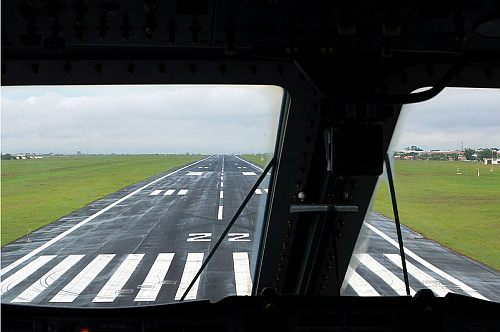
São Paulo – The Brazilian government has launched a regional aviation development plan in a bid to expand the country’s aviation network. The effort is based on the ascertainment that the country’s inland is underserved by a network heavily concentrated in the major cities; and that there are both the accrued demand and the purchasing power to underpin expansion. The project provides for investment of R$ 7 billion (US$ 3 billion) in 270 airports by 2017, and the goal is for 96% of Brazilians to be within 100 kilometres from an airport – a lofty target, considering the size of Brazil’s territory.
But the federal government does not plan on going it alone and wants to recruit states, municipalities, businesses and private investors for the endeavour. The General Concessions Plan for Regional Aviation (Plano Geral de Outorgas da Aviação Regional), released last August, sets forth that airports can be managed by states and municipalities or consortia thereof with Gross Domestic Products (GDPs) higher than R$ 1 billion (US$ 442 million), and allows for concessions to private sector initiative. But is the scheme attractive to businesses?
To the minister of the Brazilian Presidency’s Civil Aviation Secretariat (SAC, in the Portuguese acronym), Moreira Franco, the answer is yes, both to national and foreign investors. “As far as the government is concerned, there are no prejudgments. The concessions already granted involve private investors and international operators,” he told ANBA, mostly referring to tenders for major airports carried out over the past few years.
The federal government is already investing in major airports. According to the SAC, from 2011 to 2014, R$ 401.6 million (US$ 177.5 million, at current exchange rates) have been allocated to works at 40 different airports, and another R$ 378 million (US$ 167 million) are in the process of being disbursed. In order to encourage airlines to open new flights, the government offers to subsidize up to half the seats in regional flights, up to a maximum of 60 seats per flight. The rationale is that tickets to these flights are usually expensive. The subsidies will draw from the National Civil Aviation Fund, which in turn is supplied by payments made by concession-holders and by airport fees and charges.
Questions as to the deal’s attractiveness do not relate to potential demand so much as to the nature of the scheme itself, according to analysts questioned by ANBA. For them, the project outlined by government so far lacks clarity. “The interest is there, because Brazil’s heartland is growing,” said attorney Carlos Ari Sundfeld, a professor of Administrative Law at Fundação Getulio Vargas (FGV). “But the jury is still out on whether [investors] will see a reliable scheme. The fragmented arrangement [presented thus far] won’t help,” he said.
In his assessment, the scheme does not clearly outline how the federal government will relate to the states and municipalities. Without clearly defined roles, deals involving regional airports may prove unstable. Besides, he stresses that subsidies to airlines are still pending regulation, which leads to uncertainty. “In case of a (federal government) Budget blockade, for instance, what are the guarantees [that funding will not be affected]?,” he questioned. “Companies would be at risk of a default, in which case they would have to cancel their routes,” he remarked.
To the Federal University of Rio de Janeiro’s (UFRJ) Department of Transport Engineering professor Respício do Espírito Santo, subsidies must be very strictly regulated. “I am not against them, but great care is required, since this is an extremely sensitive matter,” he said.
He explained that in the United States, subsidies do exist, but the government determines which routes get the subsidies and sets all the parameters, whereas in Brazil it is “unclear” what the regulation will be or how government support will be overseen.
In turn, the Coppe/UFRJ Production Engineering professor Elton Fernandes considers subsidies an “anomaly.” “Putting up aircraft without a demand is flawed market logic; you are taking up airspace, burning fuel, polluting and throwing money away,” he declared. “The scenario requires better scrutiny,” he said.
Airport space
Broadly speaking, Fernandes believes the effort to foster regional aviation lacks an economic and financial feasibility study. “It is a political decision,” he said.
To him, the main issue is overcrowding at major airports, despite expansion works arising from concessions granted over the past few years. “Regional aviation does not connect small cities among themselves; it flies from the smaller to the larger cities. Where will the aircraft land in the big cities? Will there be room for them?,” he asked.
Fernandes points out that the government has given priority to expansion of major international airports, which are able to accommodate larger aircraft, and paid no mind to building secondary airports in capital cities, designed to take in flights from smaller cities.
The minister Moreira Franco counters, however, that some regional hubs both require larger flight volumes and have the purchasing power to pay for them, such as Macaé, in Rio de Janeiro, home to a strong oil industry; and Ribeirão Preto, in the state of São Paulo, and Uberlândia, in Minas Gerais, which are agribusiness hubs.
“Investors will know; they have the sensibility to assess whether the deal is safe and environment is good,” the minister remarked. As a case in point, he cites the Airport of Angra dos Reis, a tourist hub on the coast of Rio, managed by a private consortium since 2005, and set to undergo expansion works using funds from the regional aviation plan.
Fernandes believes attractive airports may be ones that explore tourist or business “niches” and do not rely on daily passenger demand alone. Besides Macaé, he mentioned the Airport of Cabo Frio, also in Rio, which is privately managed and handles international cargo flights. “The airport lives off of cargo, not just passengers. I think that if [regional airports] depend solely on passengers and there is no business orientation, they will run deficits,” he said.
Companies
Respício do Espírito Santo questions the sustainability of such broad goals as those put forth by government. “Who will want to invest in airports expansion and modernization when there are no inbound flights?,” he asked.
In his opinion, a key requisite for regional aviation to take to the skies in Brazil is the emergence of regional-only airlines and the provision of fiscal incentives to this end.
“Brazil lacks truly regional airlines, therefore stimulus should be given for industry executives and professionals to establish exclusively regional airlines, with no limitation to 100% foreign capital,” he said. “[The capital could be from the] United States, Arab countries, China, Germany. That would be a step forward in modernizing Brazilian aviation,” Espírito Santo added.
The professor’s proposition would require hefty political support, since Brazilian law does not allow for stakes higher than 49% in airlines to be owned by foreigners; therefore, the law would have to be changed. He points out, however, that in addition to drawing investment, such an initiative would bring foreign knowledge into the industry.
Espírito Santo does not believe Brazilian enterprises will be interested in regional aviation as per the government’s plans. The reason is the national market is dominated by four airlines that fly large aircraft and busy routes: TAM, Gol, Azul and Avianca.
“[Regional airlines] exist in Europe, Asia, Canada, but no one wants any part of it in Brazil, because the operating costs of a large business are huge, and they won’t bother with [routes with weak passenger demand],” he said.
The analysts believe major breakthroughs are unlikely to take place this year, because of the presidential elections due in October. “Even processes at more advanced stages, such as those involving ports, should only be completed next year,” said Sundfeld.
The minister himself agrees that the future of the program will depend on the next administration. He remarks, however, that environmental studies and Court of Auditors reviews are underway so that calls for tender can be issued, and that interested investors may contact the SAC for further information. The secretariat’s website is www.aviacaocivil.gov.br (in Portuguese).
*Translated by Gabriel Pomerancblum

