


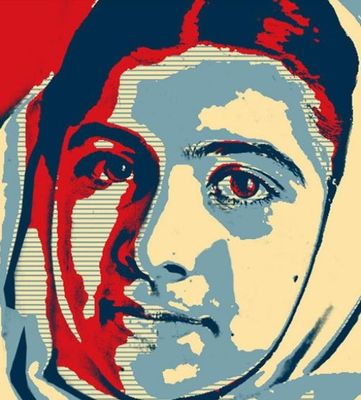
São Paulo – The young Pakistani Malala Yousafzai got famous in 2012 after being shot by the Taliban group for standing up for girls’ rights to education in her region. Her story inspired a group of students and professors at the University of São Paulo (USP), who created a magazine named after the girl the following year, in order to discuss political and religious issues of the Middle East. This month, the e-magazine Malala (www.revistas.usp.br/malala) reaches its fifth edition.
“We have a different central theme each time around. We have written about social movements in the Arab world; about the Israeli-Palestinian conflict, a hugely popular topic among Latin American intellectuals; we did an analysis of the Hamas; we discussed international non-intervention in Syrian civil war; and also Orientalism. This edition will discuss whether one can critique Islam, what are the dangers involved, and how one can go about it,” says Peter Demant, the editor in charge of the magazine.
Demant is a historian and International Relations professor at USP who specializes in issues of the Middle East, the Muslim world and Islam-West relations. The Malala magazine is an initiative of USP’s Grupo de Trabalho Oriente Médio e Mundo Muçulmano (GTOMMM), a workgroup on the Middle East and the Muslim world, and it relies on an editorial committee comprising four International Relations specialists.
The professor remarks that the goal of the magazine is to be open to a “variety of lines of thought.” “We want to avert Islamophobia, but we don’t want to adulate Islam either,” says Demant. He mentions, for instance, that the magazine’s fourth edition, on the Israeli-Palestinian conflict, outlined the views of people speaking for both sides. “We strive to keep opinions plural,” he says.
Although Brazil places great emphasis on its ties with the United States, the magazine’s editor claims he sees interest growing in the country’s ties with other areas. “Over the past 15 years, I have sensed a growing interest in other parts of the world, such as China and the Middle East. Brazil has tried to take sides with Turkey when it came to Iran’s nuclear program,” he exemplified.
He believes this increased attention is not only a function of the Brazilian government. “I feel students are very much interested in Islam, the Middle East and the Arab world. The interest is there. The challenge is to educate people [so they will accept] multiple viewpoints,” the professor remarks.
Past Malala editions feature articles, interviews, reports and surveys. Most of the material is written in Portuguese, but Demant notes that more and more works in English are being published “so they can be understood outside Brazil.” The magazine also contains material in Spanish.
Students, professors and specialists from Brazil and other countries are allowed to publish material on Malala. A call for articles relating to each edition’s central topic is placed online. According to Demant, works have been submitted from countries like Spain and Greece in the past.
Demant says the themes of upcoming editions are yet to be defined, but he believes issues such as terrorism and the Egypt scenario will likely be covered.
The fifth edition of Malala will be launched on the 27th of this month, featuring a film screening and debates at USP’s International Relations Institute.
Launch of Malala magazine – #5
November 27th, 3pm
Where: Sala da Congregação, IRI-USP (2nd Floor). Av. Prof. Lucio Martins Rodrigues, no number – travessas 4 and 5 – Cidade Universitária – São Paulo
Program:
3pm: open session “Timbuktu”
4:30pm: “O Terrorismo Islâmico no Mali” (Islamic Terrorism in Mali), a debate with Natalia Nahas Calfat
5:30pm: “Leituras, Interpretações e Críticas sobre o Islã pós-Charlie Hebdo” (Readings, Interpretations and Critiques on post-Charlie Hebdo Islam), a panel featuring Prof. Dr. Francirosy Campos and Prof. Dr. Peter Demant (via Skype), moderated by Cila Lima.
7:30pm: “O Islã, o Corão e seus Críticos” (Islam, the Koran and its Critics), a conference with Magno Paganelli and comments by Ariel Finguerut
Free admission
*Translated by Gabriel Pomerancblum

