



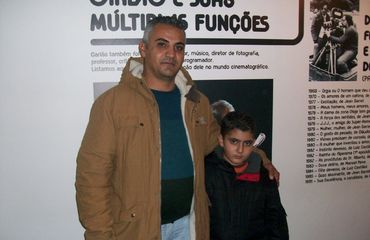
São Paulo – One camera was broken by a teargas grenade, another was damaged by a Jewish settler, the third one was shot by a soldier, the fourth camera broke in a truck crash, and the fifth camera was also shot. Thus story was made for the documentary film Five Broken Cameras, by the Palestinian Emad Burnat, which was nominated for an Academy Award in 2012 and opened the 8th Arab World Film Festival, last Thursday (15th) in São Paulo.
Burnat is neither a film director nor a producer. He used to work in field-related activities in the village of Bil’in, with 600 inhabitants, in the West Bank, where he was born and always lived. But in 2005 he bought a camera to keep track of first-born son Jibreel, as he grew up. From then on he also started filming the struggle of his family and friends in their resistance against the occupation of the Israeli army and of hundreds of Jewish settlers in Palestinian land.
The film took seven months to complete. During that time, three of Burnat’s brothers were arrested, and he spent time in prison himself. He had a truck accident, spent 20 days in a coma, saw children being taken prisoners, unarmed men being beat up, olive trees being burned, and he also filmed the murder of one of his closest friends.
Five Broken Cameras, says Burnat, is the story of Palestinian resistance told from the inside, by those who experience the day-to-day of Israeli occupation. Aged 41, married to a Brazilian woman for 20 years, the father of four sons, he has been to Europe, the United States, Canada and Japan to promote his documentary. In an exclusive interview to ANBA, Burnat discussed the film, its acceptance worldwide, and the support that he expects from Brazil and the rest of the world.
Read below the main stretches of the interview:
ANBA – In what does your film differ from all others that have been made on Palestine?
Emad Burnat – Many films on Palestine have been made by people from the outside. My film is different because I made it from my own perspective. I’ve made this film from my own feelings, from my own heart. I made this film about my experience living under occupation, under pressure from an army.
I wanted to make this film from my personal perspective, showing my son as he grows up, and presenting an in-depth depiction of family life from inside and outside. This is not merely a political film; it is mostly about daily life, about the human side of things. Everything was connected to me so it was all very touching.
The films made by people from the outside, they have never felt what it is like to live under occupation, they have never experienced it. They make films, stories. It is mostly about politics, about violence, but I took seven years of living life and resistance in my village to make this film, because I wanted to show daily life, family life. This is what makes my film different from the others.
Your film was nominated for an Academy Award, but did not win. Do you think Hollywood is prejudiced about giving an award to a film that opposes the Israeli occupation?
To me, having been nominated for an Academy Award for this film is a great achievement for the issue and the history of Palestine. However, not winning an Oscar is something that is to do with the political situation and political decisions.
You have said in the past that although your documentary has enjoyed wide publicity, it has not caused the Palestinian situation to change. Do you still hope that the film will bring about some change for the people of Palestine?
The film is more effective among people who know nothing about Palestine. The film changes people, it changes their minds, it gives them truth and reality. Thus, gradually, you can change people and the whole situation. We start with the people, who are touched by the film. I do believe that things like this can lead to change, that they can actually do something.
Brazil has supported Palestine’s recognition as a non-member state of the UN. Do you believe there are other things the Brazilian government can do to support Palestine?
Brazil is a very large country, and it can put more pressure on the Israeli government, and not back up the Israeli government. It is very important for countries like Brazil, very strong and effective countries, to put pressure on Israel for a solution, so they will give us back our land and our freedom.
Your wife is Brazilian and you could live in Brazil with your family. Have you ever considered moving to Brazil?
Here, things are more peaceful, there is more beauty and peace to life. I have been here before, in 1991, I stayed here for three months, but then I decided to go back to my home. I have never considered leaving my country and my home, because I think there is a connection. My land, my trees, my house, my family, my friends. It is all connected to me, so it is not easy leaving my country.
Do you plan on making other movies?
I keep filming. My son is eight and I keep filming life, resistance, what is taking place in my village. I hope to be able to get support from people in different countries, so I can go on making movies about the resistance. I would like to get people more involved, to get the children to make films.
On Sunday (18th), Five Broken Cameras will be screened again at Cine Sesc, in São Paulo, and Burnat will engage in a conversation with the audience. In addition to the Palestinian documentary, the 8th Arab World Film Festival will feature 22 films from the Middle East, North Africa, and Latin America. The festival will continue until September 1st in São Paulo, and then from November 4th through 16th in Rio de Janeiro.
Service
Screening of film Five Broken Cameras and conversation with Emad Burnat
Sunday (18th) at 7:00 pm
Place: Cine Sesc – Rua Augusta, 2075 São Paulo – SP
Tickets: R$ 8 (full), R$ 4 (half)
*Translated by Gabriel Pomerancblum

