



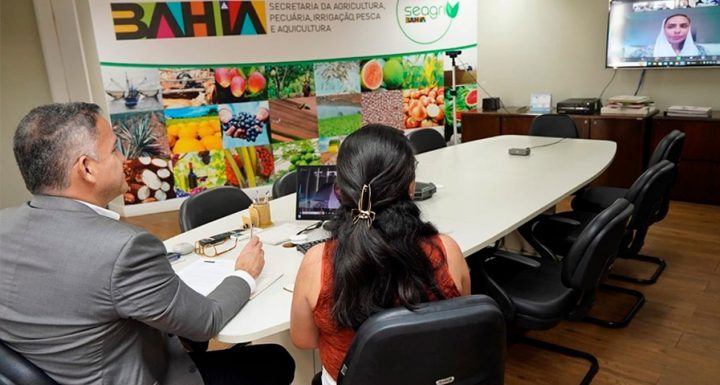
São Paulo – A technical cooperation with institutions from the United Arab Emirates to produce dates in the semi-arid region of the state of Bahia, in Brazil’s Northeast, is expected to be signed during global climate summit COP30, which is set to take place from November 10 to 21 in Belém, Brazil’s Pará state. An online meeting to finalize the details of this agreement was held on Monday (11).
An initial agreement was reached between Bahia governor Jerônimo Rodrigues, the Zayed Foundation, and one of the world’s largest date producers, Al Foah, during the politician’s visit to the UAE in 2023. Since then, the UAE has sent 110 seedlings of 12 varieties of date palms (Phoenix dactylifera) to Brazil.
The plants were kept in quarantine for 10 months at the laboratories of Brazil’s state-run agricultural center Embrapa in the Federal District. Quarantine is required for new species so that fungi, viruses, bacteria, and pests that the plant — which is not part of the country’s native flora — might bring to Brazil’s vegetation can be identified. Only after the analyses are completed is the seedling released.
Of the 110 seedlings, ten were given to the Palácio da Alvorada, the official residence of Brazil’s president, and one hundred were sent to Bahia. The seedlings were delivered in July. The date palms are to be planted in cities in western Bahia, including Presidente Dutra, São Gabriel, and Riachão das Neves, among others, according to Embrapa. With the support of institutions from the UAE, they are expected to bear their first fruits within three years.
At first they will be used by producers who already have the necessary infrastructure in place, but at a later stage of the project, they are expected to reach small family farmers, as the partnership’s aims to produce dates to supply part of the domestic market and for export.
In a statement, the Bahia Agency for Agricultural Defense (ADAB) said studies indicate that date palms adapt well to hot and dry climates, with controlled irrigation and proper management, and that the growth of this crop could represent productive diversification and a source of income for the state’s farmers. According to ADAB, over the course of five years, the project is expected to receive USD 4 million in investments and result in the planting of 10,000 seedlings.
In 2024, Brazil imported USD 9.6 million worth of dates, an increase of 57.6% compared to the previous year, according to data from its Ministry of Development, Industry, Trade and Services compiled by the Arab-Brazilian Chamber of Commerce (ABCC). The country also exported dates: USD 75,000, a value 615.6% higher than in 2023.
The main suppliers of dates to Brazil last year were Tunisia (USD 6.5 million), the UAE (USD 2.64 million), Saudi Arabia, Israel, Iran, Palestine, and Turkey. Canada, Liberia, Chile, the Marshall Islands, and Panama were the primary destinations for dates produced in Brazil.
Read more:
Dates to be grown in Bahia with UAE support
Dates: Brazil offers market potential
Saudi producer wants to sell dates to Brazil
Palestine showcases dates, olive oils at Anuga
Unaizah, land of dates and opportunities
Translated by Guilherme Miranda

