



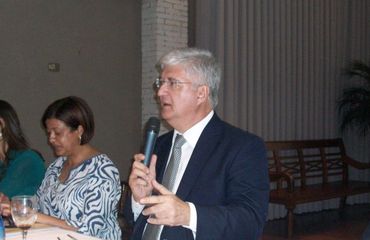
São Paulo – The Brazilian Trade and Investment Promotion Agency (Apex-Brasil) is planning to take Brazilian companies to three new fairs in the Arab world in 2016. The information was announced by the agency’s president, David Barioni Neto, in a press conference this Thursday (10th) in the city of São Paulo, organized to talk about the 2015 results and the agency’s goals for next year.
“We should add three new fairs for next year, in the food, construction industry and technology sectors”, said the executive about the planning of event in the Arab world. Barioni didn’t want to disclose the names of the fairs, since he said that the 2016 calendar would be defined in a meeting this Thursday.
“The Arab market is extremely important. I have been there myself with the Arab Chamber and with several other delegations”, he pointed out. “The Arab world has something that’s very important for us, which is the empathy for and knowledge of the Brazilian product. They have a great need for food, products for the construction industry, medical and dental products, metal-mechanics, auto parts and sustainable energy. This [2016] will be a year in which we will have very close ties with the Arab world”, said Barioni.
One of the topics of the interview was the selection of countries as target markets in the new National Export Plan (PNE), launched in June. They are 32 priority nations for the promotion actions of Brazilian products, among them Algeria, Egypt, Saudi Arabia and United Arab Emirates.
“They account for 75% of the world economy, have 60% of the [world’s] population and are 60% of the world’s total imports. These countries have considerable weight for the world’s economy. And even those where we have a small share, we want to increase it a lot”, said Barioni about the countries that are part of the plan.
Among the Arabs, Algeria is the nation that presents the weakest demand for Brazilian products. For Barioni, despite Brazil’s small part in Algerian imports, the country in North Africa presents a high demand for imports in general, which means an opportunity for Brazil. “PNE is a challenge for everyone in the government, for the ministries, for Apex, stating: the markets are there, go get them”, he emphasized.
The president of Apex-Brasil also pointed out the agency’s three new action fronts for 2016: export training focused on women; the establishing of an exports culture among college students and investments in external sales of the assistive technology sector, which includes the manufacturing of devices such as prosthesis, eyeglasses frames and devices to facilitate accessibility, among others.
In this sector, the agency plans to invest BRL 2 million (USD 526,000) to promote exports and focus sales in the United States, Argentina, Mexico, Colombia, South Korea, Saudi Arabia and the United Arab Emirates markets.
“All the buyers [of assistive technology products in the Middle East] go to Saudi Arabia and the United Arab Emirates, which have become hubs [of the sector]. It’s very important for us to invest there because in that region of the world, if we want to sell assistive technology products, the buyers are over there”, said Barioni. It’s worth pointing out that from more than 30 companies of the sector in Brazil, only two are currently selling to the external market.
The president of Apex-Brasil also emphasized the importance of the work performed by the agency’s office in the United Arab Emirates. “The office in Dubai is very important in its job of mapping out in all those [Middle East and North Africa] countries the important fairs and of establishing contacts between Brazilian and local companies”, he said. “Without this office, it would be very difficult to do business because there is [among Arabs] an eye to eye culture”, he said.
Another point mentioned by Barioni is the need for Brazil to change its image abroad to boost sales of high added value products. “All the countries that went from [the sale] of cheap products and, in a given time, started to be seen as manufacturers of good products ‘sold’ the idea of being a sophisticated society, and then culture enters the picture”, he said.
“Brazil needs to be associated to technology, to a sophisticated society, a culture and arts society. We will set up in practically all of Apex’s events a place for Brazil’s culture, showing books, cinema, awards and arts. If you don’t sell your sophisticated society with technology, you don’t leave [the sales] commodities”, he said.
In 2015, Apex supported 12,212 companies, 14.8% more than in 2014. Up until November of this year, exports by the companies supported by the agency totaled USD 55.1 billion.
Among the 218 markets that were buyers of products of the Brazilian companies supported by the agency, 10 destinations totaled USD 29.9 billion, which accounts for 54.3% of exports of these companies. Among these markets, Saudi Arabia stands in 5th place, with USD 1.89 billion in imports, and Egypt stands in 10th place, with USD 1.25 billion in purchases of Brazilian products of companies supported by Apex-Brasil.
*Translated by Sérgio Kakitani

