



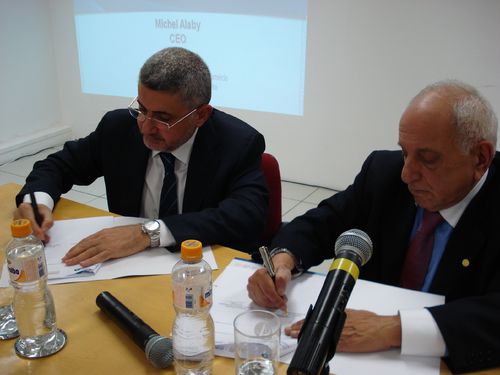
São Paulo – The Arab Brazilian Chamber of Commerce and the Egyptian Business Development Association (EBDA) signed a cooperation agreement in the area of market intelligence in sectors like energy, construction and infrastructure. The signing took place on Wednesday (8), at the organisation’s offices, during the opening of roundtables between Egyptian and Brazilian businessmen.
“Egyptian businessmen hope to improve ties with Brazil and are seeking direct contact with the trade community, with those responsible for investment in the country through the agreement signed with the Arab Brazilian Chamber of Commerce today,” said Hassan Malek, president of the EBDA. Malek is heading the delegation of 22 businessmen accompanying the visit of Egyptian president Mohamed Morsi to Brazil.
“Egypt is one of the main Brazilian partners,” said Michel Alaby, CEO at the Arab Brazilian Chamber. “The Chamber is making all possible effort to increase Brazilian imports from Egypt,” he stated.
According to Malek, to the Egyptian businessmen, the trade balance figures between both countries are “unacceptable” “Egyptian exports to Brazil are no greater than US$ 250 million, while Brazilian exports to Egypt exceed US$ 2.8 billion,” he recalled. We have a specific national project for Suez Canal, and there are large investment projects in Suez, mostly for the naval industry. We have several opportunities for cooperation and investment between both nations,” he said.
According to the EBDA president, Egypt has significant projects and investment opportunities in sectors like infrastructure, petrochemicals, railways, electric energy, ports, agriculture and livestock. “We have new and elaborate investment plans from a new government and are sure that Brazilian companies may benefit from these projects and plans and participate actively in their execution,” he said.
Malek stated that “president Morsi supports businessmen, supports public-private partnerships, provides incentives to internal investment by Egyptian businessmen in Egypt and foreign investment in the country too.” We are currently elaborating laws to provide incentives to local and foreign investment, laws on transparency, good governance; we offer tax facilities to foreign investors. We are opening Egypt to all,” he finished off.
Also participating in the opening of the roundtables was the Arab Brazilian Chamber’s International Relations vice president, Helmi Nassr, and the head of the trade office of Egypt in São Paulo, Alaa El Din Radwan.
Brazilian fruit
One of the main fruit and vegetable exporters of Egypt, Magrabi Agriculture, is going to sign a contract with the Brazilian Agricultural Research Corporation (Embrapa). “Through the agreement we are going to take to Egypt some of our material in peach and plum research to test and see if they develop there, for us then to establish a partnership to produce not just here in Brazil but there too,” revealed Ana Paula Vaz, researcher at the Embrapa, who participated in the meetings at the Arab Brazilian Chamber. Vaz explains that the contract will be signed on Thursday (9) and the material will be taken to Egypt yet this year. Fruit production should start in two years.
“Embrapa is one of the largest research centres and is much renowned in Egypt, and they are breeding many varieties of fruit that may be planted in our country. It is very advantageous to have new Brazilian varieties in Egypt,” stated Abdel Hamid Demerdash, managing director at Magrabi.
According to Demerdash, the main advantage of the agreement with Embrapa is to have access to new varieties, sweeter fruit or ones that grow in less time than usual. “Egypt is greatly interested in new fruit varieties to be able to export to Europe and other countries,” he explained.
*Translated by Mark Ament

