



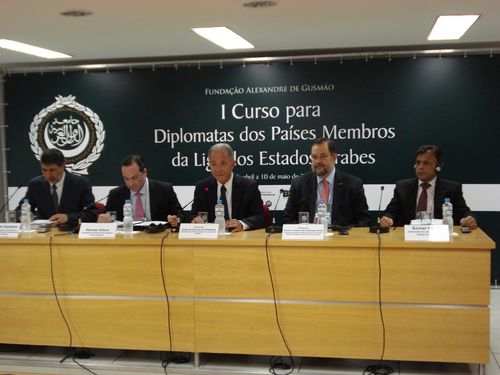
São Paulo – The historic relations that unite Brazilians and Arabs, from the arrival of immigrants from the Middle East to the expressive growth in bilateral trade between both regions over the last ten years, were some of the themes discussed on Monday (29), at the opening of the 1st Course for Diplomats of the Member Countries of the League of Arab States, which took place at the Arab Brazilian Chamber of Commerce headquarters, in São Paulo. The course is organized by Alexandre de Gusmão Foundation (Funag), connected to the Brazilian Foreign Office (Itamaraty), and ends on the 10th of May.
“The course is an opportunity for us to learn, to become better known and to make contacts. The relations between Brazil and the Arab countries is historic, but has been gaining force in recent years,” said Funag president José Vicente de Sá Pimentel.
“For 10 years, bilateral trade between Brazil and the Arab nations was about US$ 5 4 billion. Today, it is over US$ 25.9 billion,” said Marcelo Sallum, president at the Arab Brazilian Chamber. “We cannot stop at that, and believe we can do much more,” he said.
“The course is a pioneering initiative that will make the difference in relations between Arabs and Brazilians,” said Ibrahim Alzeben, ambassador of Palestine and dean of the Council of Arab Ambassadors in Brazil. “You are young diplomats who will serve as a bridge for relations between Brazil and the Arab world,” he said, addressing those participating in the course.
“Relations between Brazil and the Arab countries are characterised by much respect between both governments and people,” said Bachar Yaghi, head of the delegation of the League of Arab States in Brasília. “The course broadens bilateral relations and we provide all our support to this initiative based on cooperation and respect,” he added.
Those participating in the course heard stories about the first Arabs who got to Brazil and could understand how the formation of the Arab colony in the country took place. “Arabs have been in Brazil since the second half of the 19th century,” recalled Salem Nasser, president of the Arab Culture Institute (Icarabe). “The first wave of Arab immigration was Christian. The most recent waves were Muslim,” he explained.
Paulo Cordeiro de Andrade Pinto, undersecretary general for Africa and the Middle East at the Brazilian Foreign Office (Itamaraty), recalled that emperor Peter II studied Arabic and even visited Beirut, Damascus and Jerusalem.
New embassies
The course received over 20 diplomats from Arab countries that have embassies in Brazil, like Saudi Arabia, Algeria, Qatar, Egypt, the United Arab Emirates, Iraq, Jordan, Kuwait, Lebanon, Libya, Morocco, Mauritania, Oman, Palestine, Sudan and Tunisia; and also participants of nations that do not yet have representation in Brasília, like Somalia, Yemen and the Comoros.
“The course is very important to expand relations between the Arabs and Brazilians. Relations between Somalia and Brazil are very good and important and our government plans to have an embassy in Brazil,” said Ali Omar Afrah, first secretary of the embassy of Somalia in Egypt.
Another diplomat in Brazil for the first time is Mohamed Ali Alnajar, deputy director of the Foreign Relations Department at the Foreign Ministry of Yemen. “We are sitting the course considering the perspective of strengthening relations between Yemen and Brazil. We have serious plans to open an embassy in Brazil. Relations between Yemen and Brazil are very important for us and we believe that the opening of an embassy here should help simplify relations. It is our priority to open an embassy here and I hope that that may take place soon,” he said.
Adbou Raouf Hamadi, general director for Arab Affairs at the Foreign Ministry of the Comoros, believes that the course will be useful to him. “Brazil is still little known in my country. My role is to return and establish a link between Brazil and the Comoros,” he pointed out.
Salwa Mowafi, the first secretary at the undersecretariat of the Ministry of Foreign Relations of Egypt for the Gulf Cooperation Council (GCC) and Yemen, was one of the few women present at the course.
“We see Brazil as a developing country that managed to evolve and reach a high level of development at a short period and this is an inspiration to many Arabs,” he said. “We want to strengthen relations with Brazil, of course, but we also want to know how you managed this development in such a short period,” she explained.
According to Mowafi, Egypt has several women in important diplomatic positions worldwide. When asked, she said that she would greatly like to see an ambassadress in Brazil. “It is a very good country and the people are very receptive,” she finished off.
*Translated by Mark Ament

