



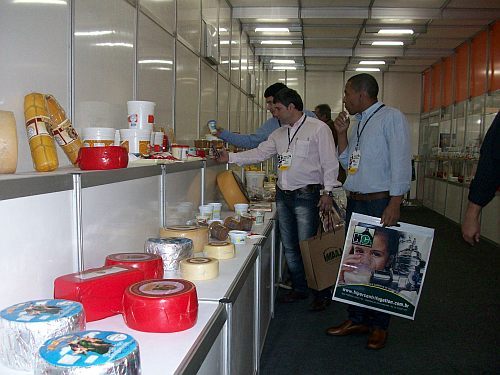
Juiz de Fora – Despite being the fourth largest milk producer in the world, Brazil is not among the largest dairy exporters, but that should change over the next decade, with increased production and trade promotion activities. With greater production and publicity, the country may, by 2023, rank as the seventh largest exporter in the world, forecasts Vilela Duarte, head of the Dairy Unit at the Brazilian Agricultural Research Corporation (Embrapa), during a seminar held at the Minas Láctea fair, which began in the city of Juiz de Fora, in the state of Minas Gerais, on Tuesday (16).
"What we expect from now to 2023 is for a definite insertion into the international market. We are growing at a rate of over 4% a year," said Vilela. “We hope to continue growing at this rate so that by 2023 we may be among the seven main dairy exporters in the world. In the worst case scenario, we will be producing over 44 billion litres of milk in 2023, and in an optimistic scenario, we will be close to 50 billion litres of milk. It is within this context of expected growth that people think Brazil will be among the seven major dairy exporters in the world, "explained Vilela. Today production is 32 billion litres a year.
According to him, the global scenario is favourable to the growth of Brazilian exports, with better prices, higher consumption of dairy products and changes in eating habits in countries that didn’t use to consume dairy products, such as the Asian nations. The head of Embrapa further noted that growing incomes in emerging countries, in general, favours the consumption of dairy products.
"Higher per capita income is directly related to greater consumption of dairy products. Not milk itself (the liquid), but mainly yoghurt, cheese, etc. So, as world per capita income, mainly in developing countries, is on the rise, growth in consumption of dairy products is expected to be greater than that of liquid milk, partly due to the ease for transport, as most trade today is in the form of powdered milk and cheeses, etc.," he said.
Regarding dairy production in Brazil, Vilela said that the main producing areas are very competitive, reaching up to six thousand kilograms of milk per cow per lactation. "These are significant figures that grant us competitiveness out there. In terms of quality, there has been a lot of work on improvement since the late 90s. Brazil’s main dairy producers are currently in the Centre-South, and the quality of the milk lacks nothing according to international standards," he added.
International Promotion
The first action for international promotion of the Dairy Export Sector Project (PS-Lácteos) is taking place at the Minas Láctea, conducted jointly by the Brazilian Export and Investment Promotion Agency (Apex) and the Organization of Brazilian Cooperatives (OCB) with support of the Ministry of Agrarian Development.
The project has brought to the fair buyers from the Emirates and Venezuela to meet dairy production in Brazil and to talk to Brazilian companies attending the event.
"We have never before promoted the sector at international events," said Marcos Soares, manager of the Apex Project, explaining the reasons for limited Brazilian dairy industry exports in 2012, which reached 43,100 tonnes of products, with revenues of US$ 119.6 million.
He recalled that the companies participating in PS-Lácteos have defined six target markets for exports: Algeria, Saudi Arabia, the Emirates, Egypt, Iraq and Venezuela. "The idea, now, is to work, learn more, and to develop prospecting work in these markets, i.e., to learn the import requirements of these markets and also to work on promoting Brazilian companies and products in these markets," he explained.
Currently, the largest dairy producers in the world are, in this order, the United States, India and China. The world’s leading exporter, however, is New Zealand.
*The journalist travelled at the invitation of PS-Lácteos. Translated by Mark Ament

