



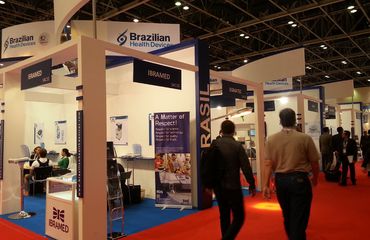
São Paulo – People visiting the Brazilian pavilion at the Arab Health fair, due in Dubai, United Arab Emirates from January 27 to 30, de 2014, will compete for a pair of tickets to the 2014 Fifa World Cup final, due on July 13th at the Maracanã stadium, in Rio de Janeiro.
The Brazilian participation in the event is a partnership between the Brazilian Association of the Industry of Medical, Dental, Hospital and Laboratory Articles and Equipment (Abimo) and the Brazilian Export and Investment Promotion Agency (Apex).
“Apex is one of the World Cup sponsors, and as such it has a few tickets. It has signed a memorandum of cooperation with the Arab Health organizers to give away two tickets for the World Cup final to a visitor interested in buying Brazilian products,” explains Clara Porto, Abimo’s commercial promotion coordinator.
The Apex will pay for the tickets, lodging, and hospitality activities, such as a cocktail party the day before the game, and the winner and their companion at Fifa box seats. The Arab Health organizers will meet air ticket costs and pay for the promotion’s marketing campaign.
“The promotion was designed to direct the flow of visitors into the Brazilian pavilion. The entire campaign is focused on publicizing the pavilion’s location,” says Porto.
Not all visitors will be running for the tickets, however. Only businesspersons will be eligible. Porto says the fair receives approximately 115,000 visitors per edition. Of these, roughly 90,000 are people who go to the event to do business, while the remainder are healthcare professionals or speakers.
The companies
Next year, the Brazilian pavilion at Arab Health will feature 40 companies. The products on sale will include orthopaedic, neurological and silicone implants, incubators, breathing devices, laboratory and electrosurgery products, physiotherapy devices and others.
Out of the Brazilian companies due to attend the event in January, three will participate in Arab Health for the first time: Sincron (nurse call systems), Russer (surgical instruments) and Silmag (catheters, cannulas and drainage tubes).
“The fair provides access to the entire Middle East market,” said Porto regarding Arab Health, noting that the event is a gateway not just into the Emirates, but into the entire region. According to the Abimo coordinator, the Middle East “remains a target market” for Brazilian healthcare products.
At the event’s last edition, in January this year, Brazilian enterprises made contact with approximately 2,600 clients from 74 countries. “Most of these contacts were from Middle East countries, like Saudi Arabia, Emirates, Egypt, Morocco, Iran, Iraq, Libya, Jordan and Syria,” says Porto.
During the fair, Brazilian companies closed US$ 1.5 million worth of deals, and expect combined sales to exceed US$ 10.825 million in the 12 months following the event, as a result of contacts made at Arab Health.
Porto explains that presently, Brazil’s main competitors are not countries like United States or Germany, which are already the leading exporters of hospital products. “Our competition is companies from countries whose level of technological development is similar to ours, such as South Korea and China,” says the executive. Brazil competes with Korea in quality and with China in pricing.
When it comes to selling to Arab countries, however, product cost is not important. “The Middle East markets value quality. Europe’s CE and the United States’ FDA certifications are required by many countries today. These are not just desirable; they are a demand,” she says.
Dental show
Brazil will have a pavilion at the International Dental Conference & Arab Dental Exhibition (AEEDC), due in Dubai from February 4th to 6th. This year, 15 Brazilian enterprises will exhibit products such as chairs, instruments, dental implants, dental impression material, dental cement and dental consumption material (drops, dental floss, etc.), among others.
In this year’s edition, Brazilian companies participating in the AEEDC attended 730 meetings and closed US$ 1.121 million worth of sales during the event. They are expecting to close US$ 200 million worth of deals in the 12 months following the fair.
According to Abimo figures, in 2012, Brazil exported US$ 14.17 billion worth of healthcare products to the Middle East. By July this year, Brazilian exports to Middle Eastern countries amounted to US$ 7.98 billion.
*Translated by Gabriel Pomerancblum

