



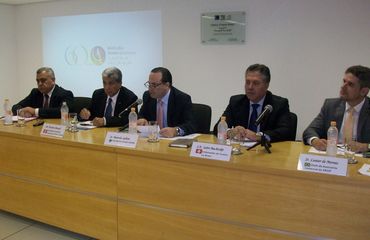
São Paulo – Brazil and Tunisia are intent on diversifying their exports portfolio and increasing bilateral trade flows. This was the primary topic of the seminar Brazil-Tunisia: Perspectives in Economic and Commercial Cooperation, held this Tuesday (5th) at the offices of the Arab Brazilian Chamber of Commerce, in São Paulo.
“Our bilateral trade falls short of US$ 500 million, and this is an extremely modest number,” said Hassine Bouzid, president of the Brazil-Tunisia Business Council on the Tunisian side. In 2014, trade between the two countries reached US$ 310 million.
“I say the numbers are modest because they could potentially go up in both Brazil and Tunisia. We sustain very strong ties and we intend to see a twofold increase over the next few years, and even reach US$ 1 billion. Why not?,” said Bouzid, who served as Tunisian ambassador in Brasília from 2000 to 2005.
In his presentation, Bouzid listed Tunisian industries that could increase their exports to Brazil, which currently consist of products such as fertilizers, electrical devices and materials and chemicals.
He believes his country could sell more auto and aircraft parts, carry out partnership projects for manufacturing pharmaceuticals, and encourage mutual tourism and reciprocal investment.
The event was attended by executives from Brazil and a few from Tunisia, who are in Brazil to exhibit at the São Paulo Supermarkets Association fair (Apas), underway until Thursday (7th).
Marcelo Sallum, the Arab Chamber president, pointed out that recent changes in Tunisia’s political scenario will likely benefit investors looking to operate in the country.
“Tunisia has displayed an amazing ability to transform. It has recently enacted a new constitution, it works hard to improve its infrastructure, industry, education and welfare, and sustains important agreements with the Arab countries and the European Community,” he said.
“There are vast opportunities for business and a strong symbiosis between our countries, not only in trade, but also investment, tourism and healthcare,” he added.
Sabri Bachtobji, the Tunisian ambassador in Brasília, discussed the 2014 elections that produced a new president, Beji Essebi, and a new Parliament. A coalition government was formed with prime-minister Habib Essid at the helm.
“These new institutions, which have a five-year mandate, inaugurate the Second Republic under the aegis of stability, a key condition in any attempt to achieve good results. This is a major milestone in the history of the country, which needs to join democracy, economic prosperity and social solidarity. This happened as Brazil experienced a similar post-election period, which gives us all the more reason to aspire to a true boost in our relations,” he said.
Lanier de Morais, head of the Brazilian Foreign Ministry’s press office in São Paulo, remarked that in 2014, Tunisia was Brazil’s 80th leading trading partner, and that bilateral trade flows are not as high as they once were. “Trade volume peaked at US$ 489 million in 2012. In 2013, trade was down 12.7% from 2012, primarily due to slower sugar exports from Brazil. In 2014, there was a new decline, at 27.3%,” he said.
The diplomat also elaborated on the potential for mutual investment. “The level of investment between Brazil and Tunisia is seen to fall short of the potential of our markets. Thus, stronger cooperation is advised between investment promotion agencies on both sides, as well as contacts between the Brazilian and Tunisian business communities,” he stressed.
Riadh Attia, the joint CEO of the Tunisian Export Promotion Center (Cepex), showed data on trade and investment in his country. “Tunisia exports to 167 countries, and France is the number one investor in Tunisia, followed by Italy and Germany,” he said.
The executive claimed European Union countries are Tunisia’s primary trade partners, whereas trade with South American countries is no higher than 1% of total exports from Tunisia.
Michel Alaby, the Arab Chamber CEO, spoke on the private sector’s influence on talks for a free trade agreement between Tunisia and the Mercosul. “It is time for Brazilian businessmen to try and influence these talks, and for Tunisian executives to influence Tunisia and Mercosul into lowering their tariffs,” he said.
Business Council
On Wednesday (6th), the Brazil-Tunisia Business Council renewal will be signed. The organization was established on March 15th, 2002 and has been inactive for a few years now. This Tuesday afternoon, a meeting of members was scheduled to outline the Council’s terms and activities.
“The object of this Council is to see how we can diversify, foment and consolidate the volume of our bilateral trade, because what we have now is too little when compared with our ambition and the quality of our political ties. We must multiply the meetings between business executives from our countries,” Bouzid said.
According to him, promotional actions are required for auto parts, aircraft parts, electrical and mechanical products, and others.
Rubens Hannun, the Arab Chamber Foreign Trade vice president, will take office as president of the Council on the Brazilian side. The organization will comprise seven Brazilian sectorial organizations and seven Tunisian ones.
“We will need to set quantitative targets for increasing trade, and this involves areas such as tourism, whose potential requires hard work to fulfill. We must also increase olive oil and dates exports,” said Hannun, who also mentioned consumer electronics and pharmaceuticals and the need for projects carried out in tandem.
“At the Arab Chamber, we have a medical project that is beginning with Tunisia, with Brazilian hospital Sírio Libanês providing training in liver transplants, and this also entails pharmaceuticals, hospital products, furniture… The project includes all of those aspects. We must also increase Brazilian participation in missions and trade shows in Tunisia,” he said.
*Translated by Gabriel Pomerancblum

