



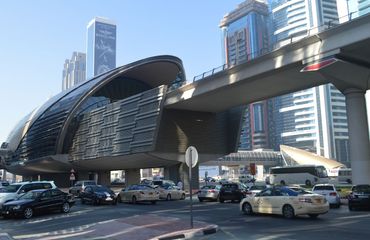
São Paulo – Delegates from Brazil’s National Railway Passenger Transporters Association (ANPTrilhos) paid a technical visit to the Metro system in Dubai, United Arab Emirates, on the last 28th. The purpose was to witness the local subway’s operation and maintenance systems.
ANPTrilhos is a civil association of all Brazilian passenger train and metro operators, including tourist trains. During the visit to Dubai, the association’s superintendent Roberta Marchesi and CEO Rodrigo Vilaça toured the operational control and maintenance centres and travelled the entire line. They were welcomed by Dubai Metro’s head of Planning and Performance, John Grainger, and Operations manager, Steve Morrison.
“The Dubai Metro is fully automated and employs a driverless system (with no conductors). It is the largest metro in the world to operate with this system,” Marchesi explains. According to her, Brazil is going through a great phase when it comes to the planning and expansion of railway passenger transportation systems, with new lines being built and older ones being overhauled. According to the superintendent, the driverless system should start being utilized in new lines in Brazil.
“Implementation of this system is a worldwide trend. It operates more safely and with greater control, in addition to reducing intervals between trains,” she says. Marchesi stresses that reduced waiting times are one of the main advantages of conductorless trains. “As a consequence, more trains and more seats are made available, especially during peak hours,” she explains.
In conductor-operated lines, the minimum interval between trains is 90 seconds; for driverless ones, it can be as low as 60 seconds. “This increases passenger numbers and streamlines several maintenance-related issues. Punctuality improves because the trains arrive on time. It is advantageous in every aspect,” the superintendent remarks.
Marchesi notes that the Dubai Metro is a global role model when it comes to operating driverless systems. In Brazil, she explains, the system is only utilized in the São Paulo metro’s Line 4 – Yellow. The Yellow Line is São Paulo metro’s only line run by a private consortium, ViaQuatro, rather than by the state government.
The superintendent claims that implementation of the driverless system in the remaining lines must be gradual. “Driverless trains require a completely different operating system. It’s not simple and it’s not cheap, but it’s feasible,” she says.
Next month, ANPTrilhos will hold an assembly where its members will be shown videos and photos of the visit to the Dubai Metro and be able to ask questions regarding its operation.
*Translated by Gabriel Pomerancblum

