



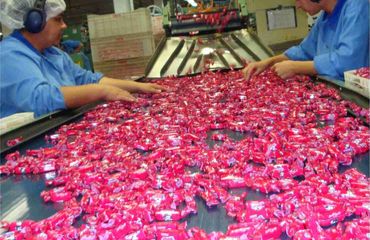
São Paulo – The sweets company from the Brazilian southern state of Rio Grande do Sul, Florestal Alimentos, started selling to the Arab countries in 2013 and now wants to expand their business in the region. This month, it is completing the requirements to obtain the halal certificate and, in February, it shall participate for the first time at Gulfood, greatest foodstuff trade fair in the Middle East.
In one year, Florestal has managed to win over the markets in Yemen, United Arab Emirates and Palestine. The products that sell the most in the region are jelly sweets and lollipops, but the company also produces hard candies, fruit or cream filled candy, caramels, chewing gum, marshmallows and mint drops, among other tidbits. The company’s clients in the regions are wholesale distributors.
According to Cleber Joner Harth, trader at the company, the decision to participate at Gulfood this year is to create an opportunity for the company to exploit the potential of the Arab market in the sweets sector. “Arab countries have great consumer potential and it is a market where we were not present yet. The trade show is very strategic and Dubai is the place to find potential clients without having to go very far,” he explains.
Currently, Florestal’s main markets are in Africa, such as Sierra Leone, Nigeria, Mozambique and Cameroon. It is also in the African continent that the trader sees greatest possibilities for increasing exports among the Arabs. “Algeria has great potential and so does Egypt. African countries have high sweets consumption,” states Harth.
Other actions mentioned by Harth to promote Florestal’s products in the Middle East and North Africa are the company’s association to the Arab-Brazilian Chamber of Commerce and obtaining halal certification, which should be cleared by January. The halal certificate indicates that foodstuff was produced according to the rules of Islamic law and does not contain ingredients that are inappropriate for consumption by Muslims.
“The Halal certificate brings greater reliability to our products. The religious aspect is very important in the Arab countries, and this way they’ll know the product was prepared for them, giving you an edge over competitors,” says Harth.
Present in over 70 countries, Florestal produces an average of 180 tons of sweets per day, of which 20% to 25% is sold to the foreign market. For 2014, the company plans on increasing their exports by 20%.
With headquarters in the city of Lajeado, Florestal Alimentos was founded 78 years ago and has an employee framework of one thousand people.
Contact Information
Florestal Alimentos
Phone No.: +55 51 8147-1718 (Cleber Harth)
Email: cleber@florestal.com
Site: www.florestal.com
* Translated by Silvia Lindsey

