



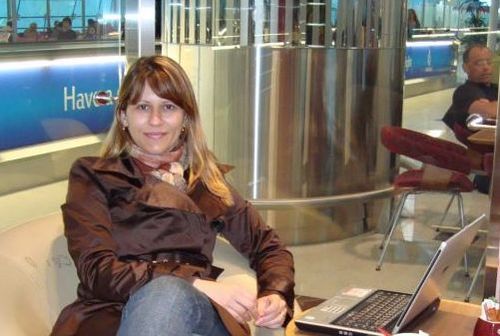
São Paulo – In early 2009, Brazilian journalist Adriana Mabilia travelled alone to the West Bank to tell stories that are little or almost unknown to Brazilian media: the fight of Palestinian women against the Israeli occupation. The result is a selection of stories of strong women who peacefully help keep up the hope that one day a free Palestinian state will be created. These stories and her own travel experience are collected in Viagem à Palestina – Prisão a céu aberto (Travel to Palestine – Open air prison), to be released on Wednesday (24) by publishing house Civilização Brasileira.
Mabilia says that she has always studied the Israeli-Palestinian conflict and that in her post-graduate course in International journalism she decided to study how the Brazilian press covered Palestinian women in this war. During her research, she contacted Palestinians and the children of Palestinians, until she got the opportunity to travel.
In the book, Mabilia focuses on three women: Nadia, Khaula and Suheier. “They were the ones who impressed me the most. They dedicate their lives to generating awareness among the Palestinian people,” said the journalist. In her work, the author speaks about the activities of these women, who work for non-governmental organisations. Between talks, protests and other activities, they teach other Palestinian women their rights, as well as offering support to those with family members in prison or dead.
“The Palestinian drama and violence to which they are submitted are common to all. This is so true that at one moment stories start repeating themselves, as is the case at checkpoints (barriers set up by the Israeli army to make it harder for the Palestinians to circulate), and with sick people who cannot get treated. There is not one Palestinian who does not suffer with the occupation,” pointed out the author.
To her, the trip only helped show how the media’s view fails to show the true situation lived by the Palestinians. “From here, you cannot imagine that an entire city is under siege; you think it’s just parts. The whole West Bank is occupied. There is no area that is not under occupation,” she said.
In Mabilia’s opinion, the world press covers the Palestinian situation badly due to “lack of knowledge and correspondents. In Brazil, we cover it through international agencies, so it is all pasteurised. Some vehicles have correspondents in the Middle East, but they are in Tel Aviv, and being in Tel Aviv is different from being in Ramallah,” she pointed out.
One of the “landscapes” that most called the author’s attention was the wall built by Israel, which could be seen from the hotel in which she stayed, in Bethlehem. “It is scary, the first time you see it. We have already had a wall separating sister populations,” she recalls, referring to the Berlin Wall, in Germany.
“On the Palestinian side, it is a large, ugly concrete wall, but on the Israeli side, it is all decorated, in some area with plants, in others with beautiful stones,” she pointed out. What has remained on either side of the wall is also very different, depending on where you are.
“You see the wall on the Palestinian side, and it is all dry, with all the vegetation on the Israeli side. The Palestinian herds have no place to graze, there is no grass. The wall was built so that all the green would stay with Israel,” she explained.
To Mabilia, the theme has not been exhausted, and she returned to Palestine in 2011. She said she will continue accompanying the situation in the region. “I want to follow what is going to change. Three generations have lived the same situation,” she finished off.
The event for release of the book should take place at the Livraria Cultura bookshop, in São Paulo, at 7:00 pm. The bookshop is at Conjunto Nacional, on Avenida Paulista, 2073, ground level.
*Translated by Mark Ament

