



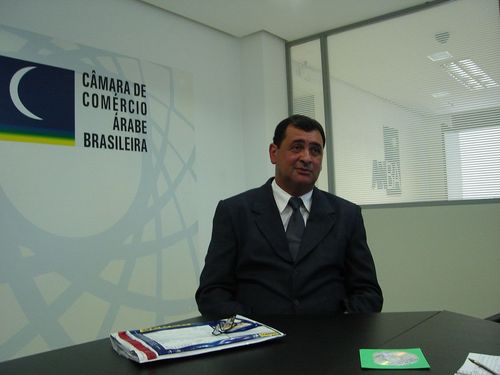
São Paulo – The Brazilian professor João Baptista de Medeiros Vargens will accept the Saudi King Abdullah International Award for Translation on October 21st in São Paulo. He is one of two winners in the Individual Translation Efforts category of the prize granted by the King Abdulaziz Public Library, in Saudi Arabia.
The prize aims to recognize translations of Arabic works into other languages and vice-versa. Categories include individual and institutional translations, and translations of works on natural sciences and humanities.
“I believe [that I have won the prize] due to the fact that I have done a few translations and edited the (Arabic-Portuguese) dictionary by professor Alphonse Sabbagh, which is of utmost importance to translating,” said Vargens, who also mentioned that he was informed of the prize via a letter.
Vargens shares the Individual Translation Efforts prize with the Spanish professor Luis Miguel Cañeda. “They are two foreigners dedicated to promoting Arab culture,” said the Brazilian.
A full professor at the Arabic Studies Sector of the Language School at the Federal University of Rio de Janeiro (UFRJ), Vargens has written the books Português para falantes de árabe (Portuguese for Arabic Speakers), Léxico Português de Origem Árabe (Portuguese Lexicon of Arab Origin), and Islamismo e Negritude (Islamism and Blackness). He is also the translator and organizer of Contos Marroquinos Modernos (Modern Moroccan Tales) and As Codornas e o Outono (Autumn Quail). He is also the founder of publisher Editora Almádena, established in 2007 to publish books relating to Arab and Brazilian culture.
In 2012, Vargens won the Unesco-Sharjah Arab Culture Prize. In February last year, upon travelling to the United Arab Emirates to accept the honour, Vargens gave a lecture on the integration of Arab immigrants in Brazil.
In July last year, he went to Morocco to participate in the Asilah Summer Festival, where he gave a lecture. “I discussed Brazil-Morocco diplomatic relations. I also mentioned that the first book ever published in Morocco, in the 19th century, was written in Portuguese,” says the professor, about the publishing of his work in the Arab countries.
To him, the fact that the award ceremony will be held in Brazil “is a bid to bring Arabs and Brazilians closer together.” He regards the honour “not as a full stop, but as a semicolon, for us to keep working.” He ascribes the success of his work to Sabbagh, his professor and great encourager.
The Spanish Cañeda, with whom Vargens shares the prize, holds a doctorate in Translation from the University of Malaga, and a bachelor’s degree in Arabic Studies from the University of Granada. He has translated several works by renowned Arab thinkers of the likes of Abi Al-Alaa, Almaari, Jabra Ibrahim Jabra, Bader Shaker Alsaib, Mohamed Binis, Marid Albargusi and others.
This month, Vargens will release yet another Arab-themed book: D. Pedro II, o primeiro arabista do Brasil? (Don Pedro II, Brazil’s first Arabist?). “I surveyed the National Library for all books on Arab culture which belonged to the emperor. The book is a commented catalogue of these works,” he says.
The award ceremony of the King Abdullah International Translation Prize is being organized by the Saudi embassy to Brasília, with sponsorship from the Arab Brazilian Chamber of Commerce.
*Translated by Gabriel Pomerancblum

