



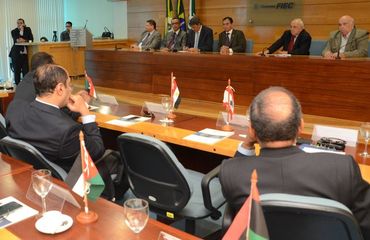
Fortaleza – The seminar Business Opportunities between Ceará and the Arab Countries, held this Tuesday (11th) in Fortaleza, brought together ambassadors from the Middle East and North Africa and businessmen from the state of Ceará, highlighting the potential for increasing trade between the state and the Arabs.
“In 2013, our exports to Arab countries grossed US$ 24.4 million. We exported foodstuffs, such as fruit, cashew nuts and fisheries, we sold shoes and leather, textiles and auto parts, but the these sales combined account for only 0.19% of the total volume shipped from Brazil to the thriving Arab market,” said Beto Studard, chairman of the Federation of Industries of the State of Ceará (Fiec), which hosted the event.
The executive highlighted the potential to increase said exports. “Ceará can do more than this. We have a GDP of R$ 105.7 billion (US$ 41.3 billion), the third highest in the Brazilian Northeast. And 21.4% of our GDP comes from our growing industry, which grew at an annual rate of 4.5% in the past five years,” he said.
According to Studard, other products the state could sell to Arab countries include off-road vehicles like those made by the Ceará-based company Troller; textile industry equipment such as domestic and industrial sewing machines; agricultural implements; carnauba wax, a typical local product used in the cosmetics and automobile wax industries; and iron and steel.
Danielle Mello, the coordinator of the National Tourism Development Program of the Secretariat for Tourism of Ceará, presented industry figures showcasing the state’s infrastructure, with two ports and 12 airports, among other facilities, and stressed the secretariat’s active role in developing local infrastructure.
“We are probably the only Secretariat for Tourism in Brazil that actually engages in construction. We had advisory (from other areas) within the government in building the roads we have built along the coast,” she said. She also stressed the state’s interest in attracting more foreign tourists. “We are an established (tourist) destination within Brazil. Our challenge lies in going international,” she explained. In 2013, tourism accounted for 10.9% of the state’s GDP.
Fernando Castelo Branco, chairman of Fiec’s Thematic Council for Economics, Finance and Taxation, discussed the potentiality of industry in Ceará. According to the executive, the state offers major investment opportunities in aviation, coastal navigation, secondary railway lines connected to the Transnordestina railway, and airport cargo.
Michel Alaby, CEO of the Arab Brazilian Chamber of Commerce, has presented economic data pertaining to Arab countries and discussed products made in Ceará that may be of interest to said countries. “With cashew nuts, for instance, you often sell it to European countries that resell to Arab ones. You must sell direct,” he said.
He also encouraged closer contact between business executives from Ceará and the Arab world. “We must work on sending a Fiec mission to the Arab countries for increased contact,” he said.
Sabri Bachtobji, the Tunisian ambassador in Brazil, encouraged local companies to expand their activities overseas. “I believe it is important for businesses in Ceará to go international. We are here to show interested parties the facilities our countries have to offer,” he said.
Meetings
Following the seminar, the ambassadors attended private meetings with local businessmen interested in doing business with the Arab countries.
Willian Costa, the Export manager for ornamental stones company Imarf, said he already ships product to the United States, Canada and China, and is interested in selling his products to Middle East countries. “It is a luxury product,” he says regarding his stones. Imarf works with marble, granite, onyx and amazonite. “The stones are used in projects such as malls, airports, hotels and high-end houses, as well as government buildings,” he explains. He said his conversations with the ambassadors were positive.
Eduardo Fernandes, the director of travel company Consultour Viagens e Turismo, wants to enter into partnerships to take tourists from Ceará to Arab countries. “Our locals travel a lot to the United States and Europe. They want to see other countries,” he said.
Kelly Whitehurst, a representative of Yamor da Ethel, a manufacturer of handmade lace and cotton items, including children’s clothes and bed, bath and linen items, also plans on selling her products in Arab countries. She says her company is willing to tailor its products to the needs of each client.
“We adapt to the local culture. We can design a specific collection for your country. We work with luxury markets, high-end materials and refined design,” she said.
Partnerships
Abd Elghani Elkarim, the ambassador of Sudan, says the visits have enabled the group to become aware of existing opportunities in trade and investment. “The State of Ceará is determined to have strong ties with the Arab world,” he asserted. According to him, the meetings with executives have been very dynamic and productive. “This is an important step taken at the right moment,” he said regarding the appointments in the state.
To Michel Alaby, the business meetings were one of the high points of the trip. “This is something we have adopted for our latest meetings, and we intend to improve them even further. We are looking into implementing a few suggestions we have received, such as holding meetings at universities, with journalists, and visiting cultural spots,” he said.
To Ibrahim Alzeben, the Palestinian ambassador and dean of the Council of Arab Countries in Brazil, “the visit has been very successful.” “We were able to take a close look at the investment opportunities and economic activities of this state. We had 60 meetings with 29 companies in various industries such as mining, tourism, energy and fertilizers,” he said.
He also underscored the Arab Chamber’s role in the trip of Arab ambassadors to Ceará. “The Arab Chamber’s participation has been decisive to the success of our visit,” he stressed. To Alzeben, support from government authorities in Ceará will be crucial in order for the visit to bear fruit. “We have sensed a decisive support from the authorities, and this is key for any future deals,” he said.
In addition to the aforementioned Tunisian and Sudanese diplomats, the event was also attended by the ambassadors of Egypt, Lebanon, Morocco, Kuwait, Jordan, Libya, Mauritania and the chargés d’affaires of Saudi Arabia and Bahrain.
*Translated by Gabriel Pomerancblum

