



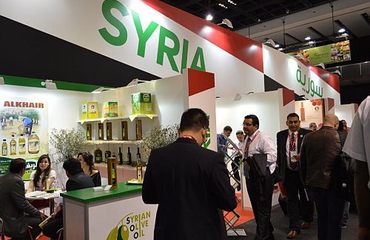
Dubai – Despite the internal conflicts underway in Syria since 2011, the country’s food industry is striving to increase its foreign sales. At Gulfood, the food industry fair taking place this week in Dubai, the United Arab Emirates, the Syrian pavilion features 16 exhibiting companies.
A wide variety of products is available, including chocolates, biscuits, oils, olive oils, nuts, dried fruits, pickles, and jellies, among other items. One would think that in a country at war, business would come to a halt, and yet Syrian companies keep producing and exporting, the scenario notwithstanding.
Kemeh Al Sham for Food Industrial Company, a manufacturer of chocolate, hard candy, wafer, and biscuits, has been on the market since 1945. “We are one of the first companies ever to make chocolate and candy in Syria,” says general assistant manager Yaser Aridah. The company also owns a plant in Jordan and ships product to 15 countries. “In Latin America, we have our products in Venezuela and the Dominican Republic,” he says. The company also sells to other Arab and European countries.
Aridah says the situation in Damascus is better than in the rest of the country, and this enables him to keep shipping his products to other cities within Syria. “Industry goes on, life goes on. Far from Damascus, there are some difficulties, but our products reach Aleppo, Homs, Latakia, Tartus and Hama,” he said.
Al Reem Can Maker was founded in 2006 and its flagship products are pre-cooked beef and chicken, but the company also makes items such as tomato extract, beans and canned fava beans. “We export to Iraq, Lebanon and Jordan. Occasionally, [we sell] to other countries, but these are the main ones,” said general manager Khaled Abou-Kharroub.
The company produces 500 tons a month of pre-cooked beef alone. The manager says he has never sold to Brazil, but began importing raw material from the country last month. “We are importing chicken from Brazil since January, 100 tons a month.” According to Abou-Kharroub, his supplier is Copacol, from the state of Paraná. He also said he plans on going to Brazil to get to know poultry and soy companies better.
Iyad Betinjaneh is the vice president of Habib Betinjaneh Est., a group active in food manufacturing, distribution, importation and exportation. Regarding production, the company makes olive oil, palm oil, flower oil and mostly olive oil, under the brand Syrian Olive Oil Co.
“We own units in Syria, Iraq, Lebanon and we represent many domestic and foreign companies,” the executive says, regarding the company’s line of business. “We used to have nine plants in Syria before the war. During the war, we had problems with some of them,” said Betinjaneh, explaining that currently, four plants are still up and running and two are being rebuilt.
“Local markets across Syria this year are suffering almost everywhere, and sales volumes have dropped because it’s hard to get suppliers, but we make four to five tons of olive oil a year,” he said.
His target markets include Arab countries, European countries, Australia and Malaysia. The company doesn’t sell to Brazil, but has imported coffee occasionally and is in talks to start buying poultry from the country.
According to the executive, it’s not easy to keep a business going in a war-ridden country, but he believes “one needs to adapt.” “We have our people there. We have over 800 people working for our company and we need to keep the business alive. How we go about it? We deal with it from one day to the next, we have no long-term strategy, you have to adapt to what’s going on. There are areas where we’ve lost everything: we’ve lost plants, we’ve lost warehouses. In other areas it’s safe to rebuild,” he said.
Wouters, a candy maker company, has existed for ten years and was founded by Holland’s Nicole Wouters, who married a Syrian man and moved to the Arab country. The company makes assorted chocolates and is set to start making biscuits as well.
According to Wouters, there’s a great market for chocolate in Syria, it was booming before the war. “Syria is known for its handmade chocolates and for the use of good cocoa butter and good ingredients,” she said.
By going to Gulfood, she hopes to get in touch with more clients in Jordan, Iraq and Yemen – countries to which she already exports. “I hope that once I’ve been to the fair, my plant will go online 24/7 and eventually put out three tons of product a day,” she said. She declined to comment on current production figures.
The businesswoman believes that once the conflict is over, businesses must be ready to resume selling. “The most important thing is for you to be prepared, because this will end and I have high hopes that it will be soon. And once there’s peace again, Syria is a strong country, everyone will come back and the country shows great promise when it comes to business,” she said.
*Translated by Gabriel Pomerancblum

