



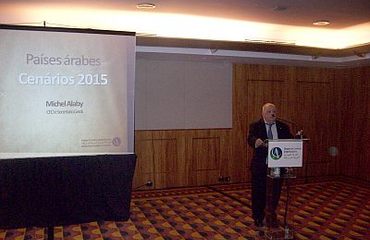
São Paulo – The difficulties of the Brazilian economy and the devaluation of the real against the dollar brought forward different challenges to Brazilian companies. Some benefited from the appreciation of the North American currency to expand their external sales, others must adapt so not to lose their market share, as some of the businessmen and executives told ANBA this Monday (30th) when attending the event Economic Outlooks of Brazil and the Arab countries, promoted by the Arab Brazilian Chamber of Commerce, in São Paulo. The seminar had presentations by Michel Alaby, CEO of the Chamber, and Daniel Hannun, Investments director.
Ricardo Gil, sales manager of Alimentos do Brasil, company that trades food products, doesn’t believe that the dollar appreciation affects negatively external sales of his sector. To him, Brazil’s strong position in the world as food supplier ensures that other countries don’t stop their search for the items produced here.
“I think that the high-value dollar is an incentive for Brazilians to export, but we expect the government to offer support to make exports easier. I don’t believe that the dollar appreciation is a good thing, we should have equilibrium, but I don’t believe it affect [exports], because the ones that already import won’t stop importing [from Brazil], especially if it’s a product that there’s plenty here and can’t be found in other regions. It will cause trouble in the matter of price negotiation, but stop importing I think it won’t happen”, he assessed.
Marília Espalaor, Foreign Trade analyst of Maricota Alimentos, says that her company was not affected by the difficulties in the external and domestic markets.
“The crisis has helped us to turn exports more favorable. We currently have a very good market in the Arab world”, she said. The executive says that the company has a distributor in the United Arab Emirates and is working to open the markets of Qatar and Saudi Arabia.
Janaína Azevedo is responsible for international sales of Lopesco, a company that produces casing (tripe) for sausages. According to her, the appreciation of the United States currency is affecting the business of the industry, which, before exporting, must buy imported inputs.
“What we hear the most from the customers is that now the dollar went up and we need to lower the prices. That doesn’t happen because the majority of the inputs that we need to feed the cattle is imported, as it’s the vaccines and vitamins. We’re the final client of the slaughterhouse, and since this is transferred into the feedstock to process and export, we also need to transfer it”, she explains.
According to her, the company is not going to raise the price of products anymore to avoid sales to stop. “We already reach a price peak, we couldn’t go beyond this, and otherwise the product will end up in stock. So, this is really a negative thing (currency rate oscillations), exports dropped a lot”, she said.
To Katia Timani, owner of Kans BR, a hair cosmetics owner, it’s necessary to use one’s creativity to take advantage of the real devaluation and the opportunities that open up in the external market.
“Brazil never ceased to go through crisis throughout these years. It’s within the crisis that we acquire creativity. It’s not nice for us to rely on the dollar to gain competitivity abroad, but rather have a domestic policy to make it easier for us to gain this competitivity abroad, but currently the possibility is based on the dollar, on the dollar rate, and I see it with a very positive vision towards exports”, she declared.
According to Stephane Perard, director-general in Brazil of the airline Emirates Airline, “aviation, in general, is being affected by the negative economic situation, but Emirates is well-prepared to deal with these circumstances”. “We made some adjustments concerning the price rate to continue to provide incentives [to Brazilians] to try Emirates and continue to travel. We had some fare reductions, had more promotions than the usual to provide the traveler with incentives to fly and remain doing what they do normally”, he said.
Outlooks
In the event, Michel Alaby talked about the economic scenarios in the Arab countries. “In the last five years, Arab imports in the world increased 50.3%”, he highlighted, pointing out the situation of these countries as a good market opportunity for Brazilian companies.
The executive emphasized the growth expected for the Arab countries, which should reach 5% among the more wealthy ones. “In the countries of the Gulf Cooperation Council, in the 2014/2015 period, we expect an average growth of 4.5%, with the non-oil GDP growing 6%, and the oil GDP at 0.5%”, he said.
For Brazilian companies, Alaby pointed out the good opportunities for exporting to the Arabs, especially with items such as grains and beef.
Daniel Hannun talked about the current moment of the Brazilian economy and its outlooks. “We have a currency rate that, especially for exporters and importers, makes it difficult because of its abrupt movements throughout the way. The ideal is for us to have a stable currency rate, in which we can plan ahead”, he said.
According to the economist, more than the dollar price in itself, the important thing is the stability in its price. “I don’t believe that we will have a level of R$ 2.20 [per dollar] anymore, because this was also an artificial level, but one of the most difficult things to forecast is the price [of the North America currency], because there are many variables”, he pointed out.
But, according to Hannun, it’s necessary to take advantage of the better competitiveness that the dollar appreciation brings to the country’s exports. “The world is way bigger than only the Brazilian domestic consumption”, he finalized.
*Translated by Sérgio Kakitani

