



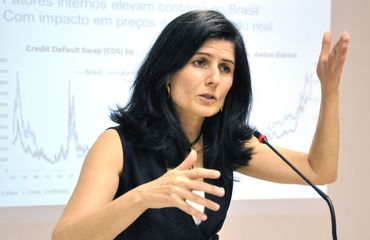
São Paulo – The year of 2016 will be a tough one for the Brazilian economy. Without a fiscal adjustment package, the country will be unable to grow or attract foreign investment again. In order to get Brazil in order, inflation must also be contained and the tax and social security systems must be reformed. So says Zeina Latif, the holder of a PhD in Economics from the University of São Paulo (USP) and the chief economist at investment firm XP Investimentos. Latif spoke this Thursday (28) to an audience of business executives at the offices of the Arab Brazilian Chamber of Commerce in São Paulo.
“Fiscal policy has become a ‘destabilizing’ element as it breeds distrust on the country’s ability to get its debt in order further on,” Latif pointed out. “Brazil carried out a subpar fiscal adjustment program, one that lacked long-term reforms to signal to investors, domestic and international, that government debt will not blow up. We failed in doing that, but at the same time [we] sacrificed ourselves by cutting spending on areas that were often connected with investments and that has hurt the economy,” she said.
The economist believes it could be a while before Brazil regains an investment-grade rating from international agencies like Standard & Poor’s and Fitch. In the final months of 2015, both rating agencies downgraded the country from BBB- to BB+, the first speculative-grade rating in the spectrum.
“The average time it takes for countries to recover an investment grade after losing it is around eight years. It might be a decade before we recover our investment grade. Hopefully I’m wrong, but [that average] is a good indication of the magnitude of the challenge we’re facing,” she said.
Regarding the weakening of Brazil’s real against the US dollar, Latif noted that the reasons are not exclusively domestic. “That has much more to do with the cycle of the US currency, which has been getting stronger since 2011. Why is American money climbing all over the world? The reason is that the United States are showing much faster productivity gains than the rest of the world, and this will likely continue to be the case. The American economy has a huge capacity for innovation,” she explained.
However, before the depreciation of Brazilian currency can benefit the country’s economy, inflation must be contained, the economist said. “The exchange rate plays an important role. If the exchange rate goes up, but inflation does too, we’ll just be spinning our wheels. If the exchange rate is to increase our export capacity and be conducive to the replacement of imports, then inflation must go down,” she emphasized.
Arabs
The economist discussed exports from Brazil to Arab countries, remarking that revenues shrank last year due to low commodity prices. As for the Arab countries, she mentioned that although some are struggling with the oil glut, Brazil has managed to keep its sales to the region balanced. “Of course, the message must be conveyed that the export portfolio needs more variety,” she said.
For Latif, the country needs to build closer ties with other nations, including Arab ones. “Calling on the government for closer ties is an agenda that must be worked on daily,” she claimed.
Regarding that, Arab Chamber president Marcelo Sallum discussed the work the organization does with the Brazilian government to put double taxation prevention measures in place “in a bid to prompt Arab funds to invest in Brazil.”
The executive also mentioned efforts regarding a Mercosur-Egypt trade agreement that was signed in 2010, but has yet to take effect because it pends ratification from the parliaments of all countries in the South American bloc. “Egypt is an excellent market and we believe that by March we’ll have an agreement with Egypt with approval from all Mercosur member countries,” Sallum said.
According to Latif, to overcome the crisis, Brazil needs “across-the-board measures”: “Simplifying the tax burden, carrying out reforms that truly allow a lower tax burden. Social security needs tampering with. Currently, the fastest growing government expenditure, the one that builds pressure and drives up taxes, is social security,” she pointed out.
*Translated by Gabriel Pomerancblum

