



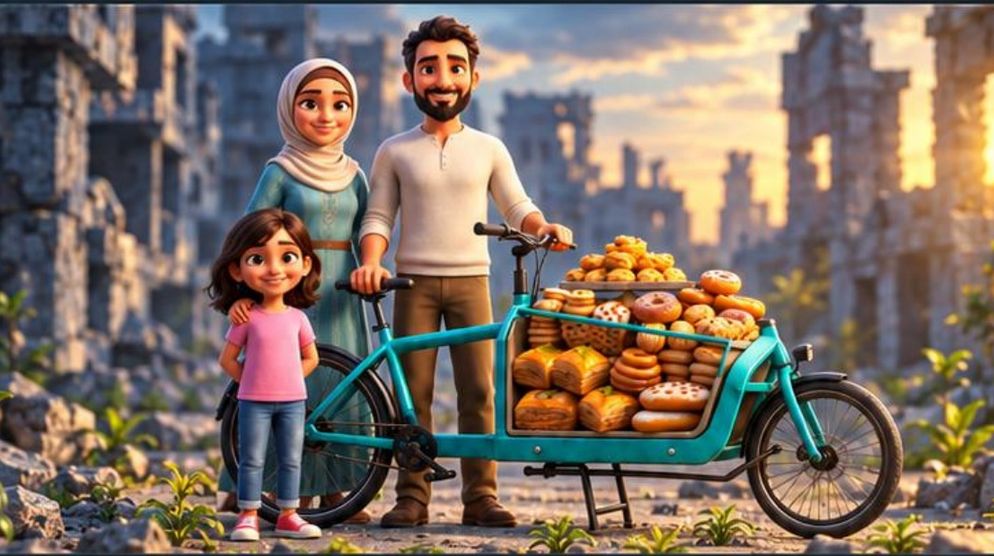
São Paulo — What is left behind when you are forced to leave your own country? And what remains within a person when nothing else is left? These questions gave rise to Yasmin, the character in Sweet Memory, an animated short film created by Brazilian director and screenwriter Gregori Fiorini. Yasmin is a Syrian girl who must rebuild her life in Brazil while preserving memories of her culture.
“I didn’t want to make a film specifically about war, but about what war cannot destroy: affection, memory, identity and the human capacity to start over,” the director says.

The six-minute, 37-second film reflects on what a child can carry when forced to leave their homeland, home and part of their history behind. When objects or photographs cannot always be taken along, memories, flavors, scents, teachings and small gestures remain. In Sweet Memory, maamoul, a traditional pastry often associated with religious celebrations, family gatherings and the passing of knowledge between generations, serves as the link to Yasmin’s homeland and family ties.
“When we think about the consequences of wars and forced displacement, we often encounter numbers, statistics and images of destruction. Yet behind these numbers are people, families, and above all, children who had dreams, games, routines, emotional bonds and a connection to the places where they were born,” says the creator of Yasmin. “I have always been interested in cinema’s ability to bring us closer to realities that may seem distant from our own but carry deeply universal emotions.”
Fiorini, whose paternal great-grandmother was of Syrian and Lebanese descent, says he considers it important for refugee children to be represented beyond their status as victims, as they have individual identities, knowledge, dreams and a rich cultural heritage that deserves recognition. Respect for Syrian and Arab cultural identity, beyond the stereotypes often seen in international news coverage, was also a concern.
“I do not intend to speak on behalf of refugees, but to help their stories be seen with greater sensitivity, respect and humanity.”
Use of generative AI
Fiorini speaks openly about the use of generative artificial intelligence in the film’s production process, bringing the topic into the discussion in a transparent and responsible way at a time of major changes in the audiovisual industry.

“I was responsible for the film’s creative concept, screenplay and direction, as well as overseeing its audiovisual development through my production company, GF Production. Generative AI was used as a support tool at certain stages of the animation’s visual development,” the director says.
“There is a difference between using a technological tool and delegating authorship of a work to it. The conception of the story, character development, thematic approach, narrative choices, artistic direction and creative decisions are the result of a human process,” he explains. “Technology is part of this process, but it does not replace artistic intent.”
For him, the issues that need to be discussed include authorship, copyright, ethics, the work of creative professionals and the limits of using these tools. At the same time, he believes new technologies can expand opportunities for independent filmmakers, especially those like him who lack the financial resources of major studios.
Naples festival
Although the film follows a Syrian girl starting a new life in Brazil, the emotions it conveys are universal. From the outset, the intention was for Sweet Memory to engage audiences from different countries and cultures, which is why Fionini made an English version of the film. There is little dialogue because he chose to emphasize images, music, gestures, silences and the character’s expressions as forms of communication.
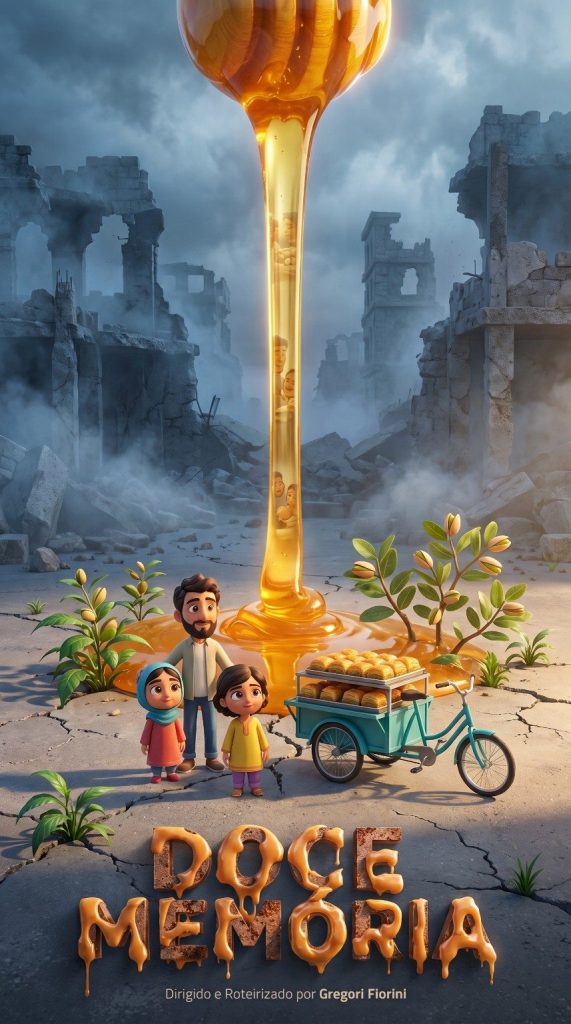
The English version helps the film reach international audiences. In November, Fiorini traveled to Marano di Napoli, in the Naples metropolitan area of Italy, to attend the 29th edition of the Marano Ragazzi Spot Festival, where Sweet Memory was part of the official selection. The film was presented under the title Dolce Ricordo.
“This selection has a very special meaning for me, especially because it is a festival that fosters an important connection between audiovisual production, young people and the education of new generations,” the director says.
The film’s international circulation has also brought it visibility in media outlets and specialized publications in several countries, including Italy, Morocco, Belgium and some Middle Eastern countries.
“It is very meaningful to see an independent production developed in Fortaleza, Brazil’s Ceará state, establish connections with audiences and cultures so different from its own,” he says.
Alongside its festival screenings, GF Produções is developing the Sweet Memory in Schools project, which seeks to make the film available free of charge, with permission, to schools, cultural centers and organizations interested in fostering discussions on childhood, cultural diversity, migration, welcoming refugees and human rights. A teaching guide is also available to help teachers and facilitators conduct these activities.
Originally from Fortaleza, Fiorini holds a degree in Film and Audiovisual from the University of Fortaleza (Unifor). His professional career spans film, television, documentary production and institutional audiovisual work. His film projects include The Spells of Daniel Hourdé (2016) and Between Musical Notes, I Composed My Dreams (2019). Based in Fortaleza, GF Production develops projects in film, communications, education, culture and accessibility.
Read also:
New platforms expand access to history
Report by Débora Rubin, in collaboration with ANBA
Translated by Guilherme Miranda
