



São Paulo – The Secretary-General of the Union of Arab Chambers, Khaled Hanafy, told ANBA on Wednesday (29) that halal products—made according to Islamic standards—partially meet criteria required for a more sustainable world. He added, however, that a different approach to halal is required.
“The approach takes the environment into account—we are talking about a sustainable environment within the ‘halal formula.’ We also consider the environmental impact of businesses and governments,” he said. “We need to present the concept of halal in an enhanced version that also considers social responsibility,” he told ANBA during a visit to the Arab-Brazilian Chamber of Commerce (ABCC).
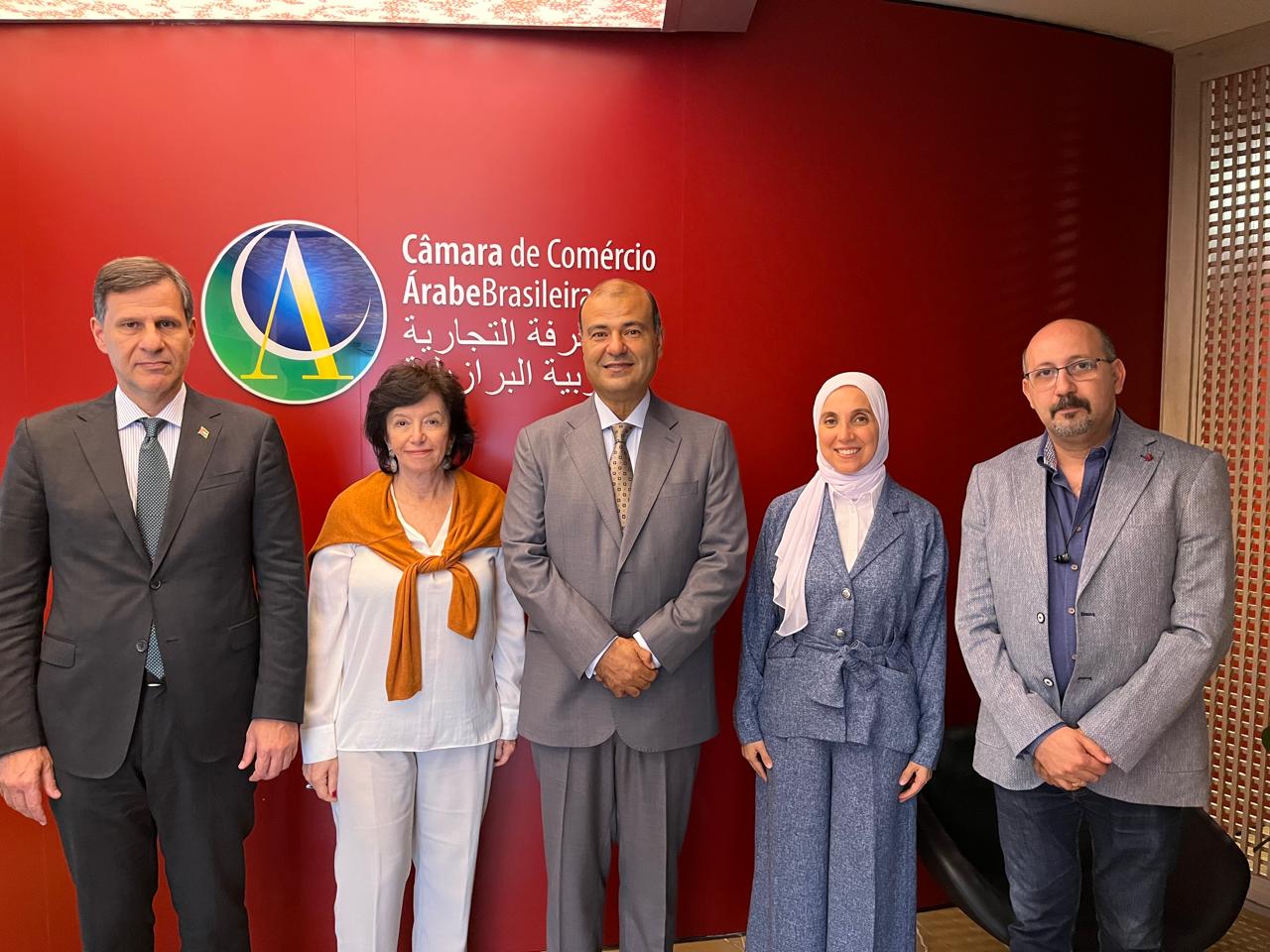
Hanafy and the Dean of the College of International Transport and Logistics, Sarah Hassan Kamal El Gazzar, met at the ABCC’s headquarters in São Paulo with its Vice President of International Relations & Secretary-General, Mohamad Orra Mourad, Vice President of Marketing Silvia Antibas, and Michael Gamal, Director of the ABCC’s office in Cairo. They came to São Paulo to participate in the Global Halal Brazil Business Forum, organized by the Arab Chamber and FAMBRAS Halal Certifier on Monday (27) and Tuesday (28). Halal products are made according to high standards of hygiene, sanitary controls, and animal welfare, and are certified by companies.
El Gazzar said halal is capable of meeting the demands for a more sustainable world, but it still does not fully achieve these goals. “And it’s not because halal is incapable of meeting them, but because companies cannot fully comply with all halal requirements. The higher the requirements, the higher the costs,” she summarized. “We need to find a formula through which we can achieve the maximum halal specifications at the lowest possible cost so that the market can commercialize them,” she added.
At the meeting, El Gazzar and Hanafy said Brazil, the world’s largest supplier of halal meat, should have a more strategic and integrated relationship with Islamic countries. She mentioned as upcoming measures the establishment of companies in the Suez Canal economic zone in Egypt, from where products would be re-exported to other destinations. El Gazzar also commented that the long-demanded direct flight between Brazil and Egypt is no longer a “necessity” but an “obligation.”
“It’s essential, not just a necessity. There must be a direct connection, from a logistical standpoint, between Brazil and the Arab countries in Africa. We’re talking about a direct connection using both air and maritime transport,” she said.
Read more:
“When women thrive, humanity thrives”
Halal forum opens with focus on ESG, trade
Translated by Guilherme Miranda

