



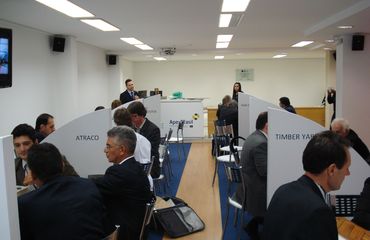
São Paulo – Brazilian companies looking to either enter or expand in the Middle East market are taking advantage of the Projeto Copa (World Cup Project) matchmaking rounds, which kicked off last Monday and will close this Tuesday (18th) in São Paulo, to promote their products and win new clients. The negotiation is taking place at the offices of the Arab Brazilian Chamber of Commerce through a partnership with the Brazilian Export and Investment Promotion Agency (Apex).
One of the Brazilian enterprises which attracted attention from Arab importers seeking building materials was Ceará state’s Tecnopet. The 15-year-old company makes tiles, bricks, doors, roof tiles, piping and other construction items, all made from PET bottles.
“We export to two countries in Africa, and now we are here to seek out this fantastic market, the Arab market,” said Tecnopet chairman Maurício Jackson. The company boasts a product line of 25 different items, and is also active in the auto, nautical and furniture industries. Its entire production is shipped to the two African countries. “We are working on expanding our business in order to meet the local demand as well,” said Jackson.
Still, the plans of serving the domestic market have not taken the company’s focus away from foreign countries. “We are setting up operations in a Export Processing Zone in the state of, and we need strong partners,” he said. According to Jackson, the company’s current output is 200 tonnes of product per month; the expansion will increase the volume to 5,000 tonnes.
One of the Arab importers who became interested in the company’s technology was Abdul Razak Yousuf, the CEO of the UAE-based Bani Yousuf General Trading. “We will speak again. He (Jackson) told me he is looking to build a plant in our country. Initially, we could buy their Brazilian-made product, and then we will see what we can do,” said the businessman.
Bani Yousuf operates as a trading company and re-exports industrial equipment, tools, building material, mobile phones, foodstuffs and other items. This is the company’s first time in matchmaking rounds in Brazil, but it does business with padlock manufacturing company Pado, in the state of Paraná.
A handmade knife manufacturer, Rio Grande do Sul’s Coqueiro is also attending the rounds to try and move its product in the Arab country. “We already export to Mercosur countries and are looking into expanding, with the Arab Brazilian Chamber providing the link to Arab companies,” said Carlos Biacchi, the company’s commercial manager.
Presently, Coqueiro ships its knives to Argentina, Chile, Paraguay, Uruguay, Peru and Mexico. At the event, Biacchi spoke with trading companies representing restaurants and store chains. He said the rounds should lead to business, and that he will wait on feedback from a company in Dubai.
The Espírito Santo state-based ornamental stone manufacturing and processing company Angraex exports to Lebanon and the United Arab Emirates, and attended the matchmaking rounds to find new customers. “We think it might be interesting to learn a bit more about the market and maybe expand, who knows,” said saleswoman Danielle Ervatti.
According to her, out of six companies she spoke with, four have potential for business. “The Arab construction market is growing. They like more elaborate products, and we have them,” she said.
Saudi Arabia’s Arabian Trading Corporation (Atraco) is one of the companies Ervatti is hoping to do business with. Businessman Hasnein Amiji said his company has two divisions, one for construction materials and the other for commodities.
“I talked to five or six companies that might be interesting, in both the construction materials and commodities,” said Amiji. He believes it is interesting to take part in matchmaking rounds in Brazil to seek new suppliers. “It is an alternative source. Brazilian product is not well-known in our market, so it is a good alternative source to product from China, India and other major countries in our market,” he said.
*Translated by Gabriel Pomerancblum

