



São Paulo – Morocco is holding a global campaign to attract investment into its industry by having foreign businesses to set up manufacturing and export operations in its territory. Brazil is one of the target countries and, as part of this campaign, the Moroccan Investment Development Agency (Invest in Morocco) and Britain’s Financial Times newspaper held the executive dinner Morocco Unlocked – strategy, business and regulatory intelligence for new investors, last Tuesday (24th) evening in São Paulo. The event was sponsored by the Arab Brazilian Chamber of Commerce.
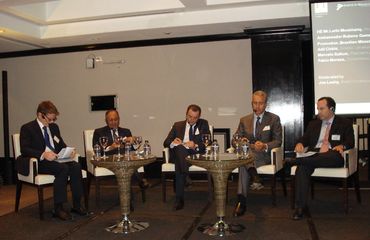
At the C-level only event, Adil Chikhi, the Strategic Marketing Development director at Invest in Morocco, Marcelo Sallum, the Arab Brazilian Chamber president, Larbi Moukhariq, the Moroccan ambassador to Brasília, and Fabio Ermírio de Moraes, advisor to Grupo Votorantim, reviewed the main advantages to investing in Morocco.
Chikhi said Brazil was picked as a target due to the size of its economy, and because the country can profit from this partnership, as can Morocco. “Brazilian investment in Morocco could help us develop our industry, create jobs and wealth in Morocco, by transferring technology into our country,” he said.
“To the Brazilian companies which are manufacturing in Brazil and selling to Latin America or South America, what I have to say is: you can manufacture in Morocco and sell to new markets. As for the companies which already sell their products in Europe or Africa, if they manufacture in Morocco, they can sell at much more competitive prices, and thus improve their profit margins,” the executive explained.
Chikhi said Morocco has several free trade agreements with countries in Africa, Europe, the Middle East and the United States, and those can benefit enterprises setting up operations in the country.
“We truly believe in these types of meetings, in which a delegate outlines existing opportunities, clears up doubts, explains the sources of financing, business opportunities, and we, as a Chamber of Commerce, must be close by in order to bridge the gap between Arab and Brazilian businessmen,” said Marcelo Sallum regarding the event. In his address he stressed that at this time, the trade balance between the two countries runs a surplus on the Moroccan side.
“For the sake of illustration, last year Brazil exported US$ 872 million to Morocco and imported US$ 1.281 billion. There is much room for improvement,” the executive said. Sallum also mentioned that the various cooperation agreements signed by the two countries need to be put to work, and emphasized the importance of resuming direct flights between Brazil and Morocco.
“I think one very important signal was the resumption of Royal Air Maroc’s São Paulo-Casablanca flights. I believe this is a clear indication of how interested Morocco is in establishing closer ties with Brazil,” he said. The Moroccan airline flew to Brazil up until 1992, and will resume flying to the country on December 9th.
According to Chikhi, Brazilian companies must not regard Morocco merely as a new investment target, but rather as an opportunity for self-development. “Ultimately, it is not about Morocco, it is about the company’s own growth. Take a company that only sells to Brazil or Argentina and picture it selling to Europe, Africa or the Middle East.” According to the executive, Morocco is interested in attracting internationalization-ready enterprises in the electronics, aerospace auto and agribusiness industries.
The Invest in Morocco director also said his country grants subsidies ranging from 5% to 15% (to investment such as land and equipment purchases) depending on the industry at hand. Tax-free machinery imports and financial incentives to personnel training are also available. “The training can take place in Morocco, France, Brazil, wherever the knowledge is,” he said.
Stable climate
Ambassador Moukhariq said Morocco has the competitive edge of political stability, which it sustained despite the Arab Spring protests that plagued the region. “Morocco took the necessary measures very early on. The monarchy understands the aspirations of the Moroccan people,” he said.
“The people went out on the streets calling for reforms and the king (Mohammed VI) responded by changing the constitution and holding elections, which led to a new government,” the diplomat explained, noting that the monarchy’s reforms kept Morocco out of the route of Arab popular uprisings.
One of the companies which are taking advantage of the good investment environment is Brazil’s Votorantim Group. It has been operating in Morocco for two years now, via the acquisition of the cement company Asment Temara. The group has invested US$ 250 million and plans on doubling that amount.
“We have a project for a new factory which should double our position in Morocco. The project is worth around US$ 250 million. Thus, combining our existing asset and our new asset, we should be investing roughly US$ 500 million in Morocco,” said Fabio de Moraes.
At this time, the Votorantim Group is manufacturing 1.4 million tonnes of cement in Morocco. “We have seen the investment climate improve fast over the past year. Morocco is a very dynamic economy,” he said.
*Translated by Gabriel Pomerancblum

