



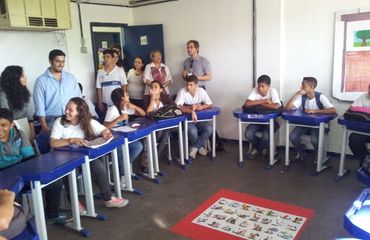
São Paulo – The Arabic language is not a common subject at Brazilian schools, but this year it has become a part of the curriculums of students at five municipal schools in Rio de Janeiro. The classes are the result of an agreement signed by Rio’s Municipal Secretariat for Education and Qatar Foundation International (QFI), the American arm of the Doha-based organization.
The partnership began in March, with a pilot project at Ginásio Experimental Carioca (GEC) Anísio Teixeira. The initiative bore fruit, and now four other GECs are already offering Arabic lessons. Ginásio Experimental Carioca is a project of the Rio de Janeiro City Hall targeting children aged 12 to 15, attending the 7th to 9th grades of primary school. These schools are attended full-time, from 8:00 am to 4:00 pm, and apart from regular classes, the students get to choose optional subjects suited to their personal interests.
“The management at Ginásio Experimental Anísio Teixeira, in Ilha do Governador, ascertained that its students have a vocation for languages. At the same time, the World Cup and the Olympics in Brazil will be great opportunities for improvement in training and work for these young people. Therefore, this school decided to broaden the scope of optional language subjects beyond English and Spanish. The Qatar Foundation International sent us a proposal for Arabic language teaching that met the needs of this school,” explains Heloisa Mesquita, advisor to the Cabinet of the Municipal Secretariat for Education and manager of the Ginásio Experimental Carioca Project.
The agreement was officially signed in August. It will remain valid for a year and can be renewed. Currently, apart from GEC Anísio Teixeira, Arabic language classes are also taught at schools GEC Rivadávia Correa, GEC Bolivar, GEC Mario Paulo de Brito and GEC Embaixador Araújo Castro.
“We are looking into expanding to other municipal schools, but we do not know many yet. That will depend on the training of teachers,” says Robert Feron, the QFI Programs coordinator in Brazil. The Qatar Foundation International is headquartered in Washington, United States, and covers the entire American continent. The funding for its activities, however, comes from Doha. According to Feron, the QFI is also in talks with the Rio de Janeiro State Secretariat for Education, and up to three state schools may become part of the project next year.
According to the executive, however, Arabic classes will not be restricted to Rio de Janeiro. “We are interested in taking it elsewhere. We are in preliminary talks with other Brazilian cities. It is highly likely that we will expand in the future, but that will depend on whether there is an interest from public schools, and teachers’ training,” he explains.
Feron explains that the teachers are hired by the QFI and paid wages similar to those of other public school teachers. This wage policy was designed so the teachers can eventually be incorporated by the municipal school network. At this time, five Brazilian teachers are working teaching Arabic at schools in Rio. Each teaches in two different schools. All of the teachers involved in the project are Brazilian. “We always recruit local teachers,” says Feron.
The classes
The Arabic classes are optional, i.e. students get to choose whether they want to attend or not. As a result, it is easy to notice the growing interest they display in the language. At the first school to adopt the course, the number of students has soared from 28 to 64. Now, the schools have a combined 130 students learning Arabic.
The classes are taught by two teachers each. Frequency varies from school to school; some have three weekly 50-minute classes and others have two 90-minute classes per week. “Some of the students are so interested they want to be a part of more than one class in the same semester,” says Feron.
According to Mesquita, the students opt to take Arabic lessons “because they have a vocation for language, out of interest, curiosity, and in order to have better chances in the future.”
The students who attend Arabic classes learn day-to-day words and the cultural context of which they are a part. “The idea is to teach a language that will make interaction easier with people from Arabic-speaking countries. They learn words that would be used in conversations about tourism, at the airport, while doing trade, selling or buying at a market, for instance,” says Feron.
The coordinator says the way the classes are taught also encourages students to learn. “The students converse among themselves, monitored by the teachers. This method is much more dynamic than just listening to the teacher speak in front of the class. The students love it, they become more involved,” he says.
On the City Hall side, Mesquita says evaluations are positive. “The International Qatar foundation is very careful about Arabic language teaching, it evaluates its teachers constantly. We are keeping track of the students’ cognitive development, to see if it improves as a function of learning more than two languages,” he says.
The QFI monitors the teachers it hires, who get instructions and feedback by telephone. They will be able to attend training abroad and be accompanied by QFI delegates who take trips to Brazil, as was the case last week, when an Egyptian teacher came to Rio de Janeiro. “He stayed in Rio for a week, sitting in on the classes and giving tips. These monitoring visits provide guidelines for future training,” Feron explains.
Other projects
Aside from teaching Arabic language and culture, QFI also develops other smaller projects in Brazil. The foundation is providing financial backing to a group of six students and three Brazilian teachers to Qatar and India, to take part in a science, technology and math contest. The event will take place in November. The foundation has also developed school projects focusing on climate change and online collaborations. It is worth noting that once a week, GEC Anísio Teixeira offers Arabic lessons to the community and to the school’s teachers.
According to Feron, QFI started operating in Brazil following a talk between the then-president Luiz Inácio Lula da Silva and the then-Qatari emir, Hamad Bin Khalifa Al Thani and his wife, sheikha Moza Bint Nasser, president of the Qatar Foundation, in 2010. “Lula encouraged the foundation to become active in Brazil, to work with the impoverished population and public schools.”
*Translated by Gabriel Pomerancblum

