



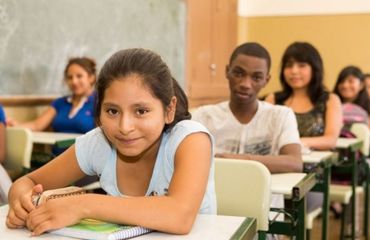
São Paulo – São Paulo state schools welcomed 8,278 immigrant students in 2015, 174 of them from Arab countries. In 2016, the school year starts on February 15, but enrolment is available the whole year. The information was supplied by the São Paulo State’s Secretariat for Education.
“We work hard in managing immigrant students. They have come to Brazil to stay, their willingness notwithstanding,” says Edina Rosa, the director of the secretariat’s Educational Inclusion Department.
Rosa notes that no paperwork is required for foreigners to enroll. They don’t need to attest legal status in the country. Students can register using whatever documents their parents are in possession of, such as the passport or the foreigner ID card Registro Nacional de Estrangeiro (RNE). She remarks, however, that more thorough documentation is required before students are awarded their certificates of completion at the end of each teaching cycle.
Not even the lack of school records constitutes an impediment to enrolment by immigrants, since school staff can apply a test to determine what grade the student should enroll in. Overall, the São Paulo state school system comprises 5,000 schools.
Adaptation
Regarding Arab students, Rosa says the state has received students ranging from 6 years old who attend primary school to students in Youth and Adult Education (Educação de Jovens e Adultos – EJA).
The director points out that adaptation becomes easier for the younger ones, whatever their nationality, as they interact with Brazilian students. “Interacting with other children makes inclusion happen in an easier way,” she claims.
She also says the Arab students are “more restrained, they’re more reserved” than those from other parts of the world. “They are the shiest, but we can tell they have a lot of respect for others. Arabs are more observing, they are quieter, but once they have observed the space they’re in, they are able to interact [with the other students],” she explains.
Teachers also play an important role in student adaptation. “The teacher in charge of the class imparts special attention [to immigrants]. They will sit the student with a colleague, not in individual activities, but to see if they can make a new friend,” she says.
Students’ grades are also monitored by the schools. “The school system offers second-chance tests and one-on-one follow-up,” says Rosa. This is how the school determines, for instance, whether the students have language-related difficulties.
The schools look to provide different forms of support to the teaching of the Portuguese language. Some of the state’s schools, for instance, offer language classes on weekends via the Family School Program – Programa Escola da Família.
At schools where this is not an option, teachers in the earlier years seek support from their English-teaching peers. “Foreign language teachers make communication easier,” says Rosa, noting that many of the foreigners in Brazil speak English.
It is worth noting that immigrant students also rely on the work of the secretariat’s pedagogical department, which assigns foreign language teachers to schools where a second language isn’t taught.
Origins
Most immigrant students in São Paulo state schools are from South American countries, like Bolivia and Argentina. Among Arab countries, last year, there were enrollees from Saudi Arabia, Algeria, Bahrain, Qatar, Djibouti, Egypt, Yemen, Iraq, Jordan, Kuwait, Lebanon, Libya, Morocco, Palestine and Syria. Syrians (65), Qataris (41) and Lebanese (29) are the majority.
The majority of immigrants enrolled in the state’s namesake capital São Paulo, but significant numbers enrolled in municipalities including São Bernardo do Campo, Guarulhos, São José do Rio Preto, Campinas, Mogi das Cruzes, Franca, Sorocaba and Jacareí.
Parents and students can find the school nearest their home here: www.educacao.sp.gov.br/central-de-atendimento/index_escolas.asp.
*Translated by Gabriel Pomerancblum

