



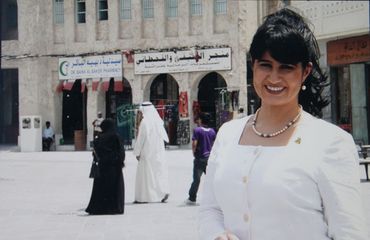
São Paulo – Claudia Assaf was born in Rio de Janeiro and has trodden many paths prior to becoming a diplomat. She graduated in mathematics, worked with computing, lived in Syria, was a flight attendant, studied journalism, international relations, and failed three times before passing the contest for Instituto Rio Branco, the mandatory academy for those aspiring to join the ranks of the Brazilian Foreign Office (Itamaraty). It has not been an easy road, and she decided to share her story with other people interested in representing the country abroad. Her experience is recounted in the book Diário de Bordo: um voo com destino à carreira diplomática (Travel Diary: a flight towards a career in diplomacy), set for release this month from the publisher Fólio Digital.
The book describes the many changes she has undergone in her life before becoming a representative of Brazil’s, and is meant to encourage people who want to follow on her footsteps, even if they have no experience in the international field whatsoever.
“The book is mostly geared towards those who do not believe it can happen. I work through my anxiety in the book. It is targeted at people who are over 30 and who hail from very different areas within the realm of diplomacy,” explains Assaf. Another highlight of her book is her learning of the Arabic language, an asset that has helped drive her diplomatic career forward.
At age 22, Assaf worked for a multinational information technology corporation in Rio de Janeiro, after completing a postgraduate course in Systems Analysis. However, being of Syrian ascent, she had a dream of learning the mother tongue of their maternal grandparents. Thus, after enrolling at the Syrian consulate, she obtained a two-year scholarship to study at Damascus University.
“I interacted with Syrian girls; they would help me and they wanted to learn everything about Brazil. I slowly realized that there was a whole other world, and math stopped making sense. I would speak Arabic 24/7, I delved into a different language,” she says.
After completing the course, she got a job with a Bahraini airline, and she also worked in presidential aviation in the United Arab Emirates. “While working in the aviation industry, I took a liking to international living. I loved Brazil and I wanted to do something international. Every country that I would go to, I would pay a visit to the local (Brazilian) embassy.”
Back in Brazil, however, she found herself without a profession. “Everything I knew about computing was outdated,” she says. It was then that she decided to change fields and go into Humanities. She took a quick course in journalism, but was also unsuccessful breaking into the market, and so she decided to bet on her dream of becoming a diplomat.
“One of the tactics I employed was to pursue a new degree. I wanted to start from scratch,” she says about her International Relations course. Apart from that, she spent many hours studying alone and with a private teacher. She had decided to keep trying for seven years, but it did not even take that long. In her fourth year she was approved.
The career
After having spent nearly a decade away from the Middle East, the region was the first choice for Assaf, who worked for approximately five years in Doha, Qatar. “Arabic is what sets me apart the most, and it has proven to be an invaluable tool,” she says. According to her, the feeling that she had succeeded in becoming what she wanted to be came during the second Summit of South American-Arab Countries, held in Qatar in 2009.
“I helped arrange the reception for president Lula with the embassy. On the day the Brazilian Air Force (FAB) landed, I, as a diplomat, was waiting to welcome the president. I was at the plane’s door when Lula got off. It is a huge honour,” she recollects, with emotion. “Then and there I knew what I wanted for my life, which was serving my country on the international front,” she says.
Presently, she is a member of Brazil’s Permanent Mission with the United Nations (UN), in New York. Assaf takes care of seven different economics and finance-related aspects. Her assignments include aiding Brazilian ambassadors at the UN during meetings, taking part in negotiations, among others.
A golden tip for aspiring diplomats? Studying the Portuguese language. “Knowing everything there is to know about economy, law and history is of no use if you cannot write proper Portuguese,” she warns. She also has a website (www.dicas-da-diplomata.com.br) and a Facebook fanpage (http://migre.me/gXwMV) designed to help diplomatic candidates. For additional tips, you will have to read the book. The launch will take place on different days in Rio, Brasília and São Paulo.
Service
Launch of the book Diário de Bordo: um voo com destino à carreira diplomática
Rio de Janeiro
12/16/2013, Monday from 6:00 pm to 8:30 pm
Cultura Bookstore
Rua Senador Dantas 45, Centro
Brasília
12/20/2013, Friday from 7:00 pm to 8:30 pm
Carpe Diem Restaurant, 104 South
São Paulo
12/21/2013, Saturday from 5:00 pm to 7:00 pm
Bibliaspa Space
Rua Baronesa de Itu, 639 – Santa Cecília – São Paulo – SP
*Translated by Gabriel Pomerancblum

