



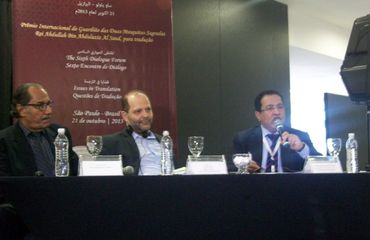
São Paulo – Translation of literary works in different languages is one of the main avenues for dialogue between people from different countries. Thus being, it is crucial for translation professionals to be familiar not only with the language into which they translate texts, but also the culture and customs of the people who will read them. These were some of the main points outlined at the Sixth Meeting for Dialogue – Translating Issues, held this Monday (21st) by Saudi Arabia’s King Abdulaziz Public Library, in São Paulo.
The meeting is part of the Honors of the Custodian of The Two Holy Mosques Abdullah bin Abdulaziz International Award for Translation. One of the prize’s winners is Brazil’s João Baptista de Medeiros Vargens, an Arabic Language professor at the Federal University of Rio de Janeiro (UFRJ).
Currently in its sixth edition, the prize ceremonies have taken place in Saudi Arabia, Morocco, China, France and Germany. “Now we are coming to Brazil because Brazil is also a gateway into South America. We are hoping to have a two-way cultural exchange Brazil Brazilian and Arab people; [Arabic] is spoken by over 100 million people,” said Faisal Muaammar, the general supervisor at the Saudi library.
“Relations between Saudi Arabia and Brazil are very important, but right now we are trying to connect the people and the languages. We are discussing translation, and translation is always a bridge between cultures, between people, between civilizations. Our strategy for this prize is to award it each year in one of the world’s leading countries that speak languages other than Arabic,” said Muaammar.
To the Egyptian-born Mohamed Habib, who has lived in Brazil Brazil for 41 years, and the biology professor at the University of Campinas, technical literary works are the easiest to translate. The real difficulty lies in translating people’s customs. “Translating engineering or physics is easy. The hardest thing is translating feelings, cultures,” he said. “The translator needs to be fully capable of producing the correct translation. And that is difficult, because a word in Arabic can have many meanings,” he said.
Luis Miguel Cañada, director of the Toledo Translation School, in Spain, who has also won the prize, noted that “translation requires effort, patience and knowledge.” He told the attendees that each year, 100,000 books are published in Spain, 25% of which are translations. Of these, however, book translated from Arabic account for a very small share. “From 1995 to 2010, 0.23% of the books translated in Spain were translated from Arabic,” he said.
To Zaid Al Assaf, director of the a Arab Centre for Arabization, Translation, Authorship and Publication, “the goal of translation is to create bridges and lay the foundation for communication and understanding between peoples.” “Without translation, books would be left to the elite alone,” he said.
Hannelore Lee-Jahnke, the honorary president of the Permanent International Conference of University Institutes for Translation and Interpreting (Ciuti), in Switzerland, stated that the issue of Arabic translators has gained prominence even at the United Nations. “My generation is retiring now, and there are no good upcoming translators,” he said.
On discussing the teaching of translaton, Martin Forstner, the Ciuti secretary general, pointed out the importance of promoting a dialogue between theory and practice. “If you want to train students to be confident translators, you need teachers with good experience in translating.”
“The practice of translating must be encouraged. The role of the translator transcends any boundary,” said Vargens. A native of Rio de Janeiro, the professor also said one must take advantage of modern translation techniques and studies, “but we must not overlook our old friend, the dictionary. “When push comes to shove, here it is, always by our side,” he said. The professor at the University of São Paulo (USP), Mamede Jarouche, mediated the debate.
*Translated by Gabriel Pomerancblum

