



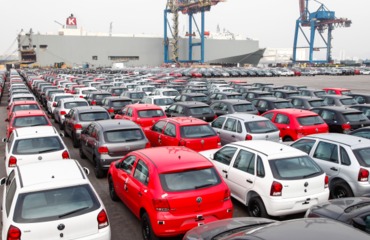
São Paulo – Brazilian vehicle exports ended 2016 with an increase of 24.7% in volume, totaling the shipment of 520,300 units among vehicles, light commercial vehicles and truck and bus chassis. The data was made public by the Brazilian Association of Automotive Vehicle Manufacturers (Anfavea) this Thursday (5).
It was the best year for exports of vehicles made in Brazil since 2013, when the sector exports 565,100 units. In 2015, foreign sales by the sector totaled 417,300 units.
In value, the Brazilian car industry generated USD 10.665 billion with foreign sales last year, up 1.6% over 2015. Factors such as the Brazilian currency depreciation and the “mix” of products help explain the gap between volume and revenues. Shipments of trucks, the product with the greater added value, for instance, increased only 2.3% in the year, and agricultural machinery, also included in the sum of the revenues, declined 5.7% in 2016.
The increase in the number of vehicles exported contributed to lessen the fall in output of the Brazilian car industry. Last year, domestic plants produced 2.16 million units, the worst performance since 2004, when they produced 2.12 million units. Compared to 2015, output dropped 11.2%.
The domestic market registered the worst result since 2006: 2.05 million vehicles were sold last year, a 20.2% fall in comparison to 2015. Ten years earlier, the domestic market had bought 1.93 million units.
In a statement, Antonio Megale, Anfavea’s president, mentioned a couple of factors to explain the decline in sales: “The first is the low confidence due to the political instability in the country, which made investors and consumers postpone their decisions. The second is access to credit, a result of social and economic circumstances that turned the financial institutions very selective when approving loans.”
Forecast
Anfavea expects 2017 to be a positive year for the sector. Forecasts indicate a new surge in exports, of 7.2%, totaling 558,000 units. The domestic market should recover slightly and go up 4%, totaling 2.13 million vehicles sold. A growth in output of 11.9% over 2016’s results is expected, totaling 2.41 million units.
“The macroeconomic environment points to positive facts, such as an increase of the GDP, inflation heading to the center of the target, continuous reductions of the benchmark interest rates and the stabilization of the dollar. Besides, the amendment establishing a limit for government expenditures was already approved, some economic measures were announced, we are seeing a stabilization of sales and we will have a low comparison level. Putting together all these factors, we believe in a serial reaction that includes a recovery of confidence levels of both consumers and investors, consumption recovery and gradual opening of credit concession,” said the president.
*Translated by Sérgio Kakitani

