



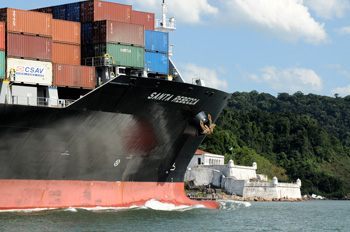
São Paulo – The São Paulo Trade Association (ACSP) should organize a technical visit to Santos port, on the 13th, to present the Porto 24 Horas (24 Hour Port) project to exporters and importers. The objective is to engage businessmen in the support 24 hour operation of the port. There are 12 spots available.
According to José Cândido Senna, the general coordinator of the Airport and Port User Committee in the State of São Paulo and of the São Paulo Export Project, 24 hour operation of Santos port is fundamental to reduce warehousing of containers and increase goods circulation in the area. Currently, the port operates from Monday to Friday, from 07:00 am to 07:00 pm, and on Saturdays up to 02:00 pm.
He explains that, currently, 56% of general international cargo containers at the port, excluding products in bulk, are for import. On average, they spend up to 16.5 days stopped at the port, as the process for customs clearance for import is tougher.
“Container delays in Santos Port complex is extraordinarily high. With this, importers must work with greater stocks, and greater stocks are more costly. This increases the process cost,” he explained.
He recalls that this also affects exporters. “The greater import stock has occupied the areas that were turned to export,” he said. According to Senna, exporters must take their cargo to the port nine days prior to loading onto the ship.
“For this to improve, for there to be greater cargo throughput, it is necessary for the organisations responsible to operate 24 hours a day, seven days a week. But this moroseness of the port complex includes not just the organisations responsible for clearance but also importers, exporters and customs brokers,” said Senna.
The organisations responsible, which work on cargo clearance, include the Federal Police, Port Authority and the Port Authority, the System of International Agricultural Surveillance (Vigiagro), the National Health Surveillance Agency (Anvisa) and the Revenue Service.
According to the ACSP coordinator, if import container delay in port were reduced from 16.5 days to 5.5 days, the port’s capacity could be increased by up to 200%. “With a 24 hour port, the offer of services would rise. The storage area would produce more and there would be competitiveness gains in exports and imports,” he said.
Financially, a reduction in storage time also importantly reduces costs for Brazilian foreign trade. Senna exemplifies that a 20-foot container, for the value of US$ 90,000 dollars, which currently costs US$ 1,800 in storage for 16.5 days, would have its storage cost reduced to US$ 720 for just 5.5 days.
With the continued operation of Santos Port, there could also be expressive growth in the number of local jobs. Senna estimates that up to 50,000 work posts could be generated.
Engagement
The 24 Hour Port project was established in 2007 by the Airport and Port User Committee in the State of São Paulo. The project has the support of the Special Ports Secretariat, connected to the Presidency of the Republic, which plans to take it to the ports of Rio de Janeiro, Vitória, Rio Grande, Itajaí, Paranaguá, Suape and Fortaleza.
Senna pointed out that, for it to become viable, it is necessary for importers and exporters to become involved, as their work is fundamental for port operation. “Brazilian businessmen complain about the Brazil cost, but effective engagement is relatively low. They participate little,” he said.
This is the reason for the visit on the 13th. The programme includes meetings with the chief Customs inspector at the Port of Santos and with local leaders of organisations responsible for import and export, a visit to a container terminal; a visit to the Port Security Control (Codesp) and a meeting with its heads, among other activities.
Those participating will also have lunch with Senna, when he will present the 24 Hour Port project. This will be the second visit for promotion of the project. The first took place on July 16th.
The visit is open to participation of exporters, importers and foreign trade logistics professionals. The costs for those interested in participating is R$ 350 for those not connected to the organisations promoting the event and R$ 300 for professionals connected to the ACSP and to the organisations supporting the visit. Arab Brazilian Chamber of Commerce associates will benefit from the discount.
Enrolment may take place up to the morning of the 11th. The programme and registration fee are available at link http://migre.me/gyP5E.
*Translated by Mark Ament

