

São Paulo – One night, a Cairo dweller receives a call asking him to set out into the sunset. While the voice echoes, Ahmad Ibn-Abdallah leaves behind his loved ones and everything he has built. Then and there, he begins a journey into self-discovery as he crosses the desert in a caravan, finds love at an oasis that is not on the maps, among other events recorded by the secretary to Egypt’s sultan.
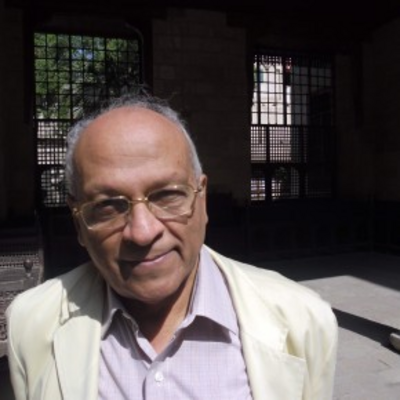
Such is the main plot of the novel O Chamado do Poente (The Beckon of Sunset, in a free translation), by the Egyptian writer Gamal Ghitany, released in Brazil by São Paulo’s Publisher Estação Liberdade last May. Ghitany is regarded as a sage of Arab language, but is little known among Brazilian readers, and this was his first work published in Brazil. Born in 1945 to a poor family, he published his first book of tales at age 14, studied arts and worked as a journalist. The book’s translation from Arabic into Portuguese was made by the translator and Arabic language scholar Safa Jubran.
Since May, 300 copies have been sold, according to the editorial director for Estação Liberdade, Angel Bojadsen. “Our sales have been relatively low,” says Bojadsen, explaining that it is difficult to promote non-Western literature in Brazil. The book was picked by the editorial director, who found Ghitany’s French editions published by Seuil, the publishing house which owns the global rights to his works, except for Arabic editions.
“I thought the approach was interesting, the writing was very good, and the plot was innovative, combining Islamic traditions as a metaphor to the contemporary Arab world. It was Ghitany’s way around Egypt’s political limitations. He was severely repressed in the 1970s. He has endured the regime’s openings and closings,” says Bojadsen. According to the director, despite being one of the trendiest writers in Egypt today, he is not much published overseas. “His oeuvre is vast and demanding,” he says.
Gamal Ghitany has published roughly 20 books, mostly in Egypt, Lebanon, Syria and France. The best known ones include Zayni Barakat, which had its first edition in 1971 and was published in Syria by the local Ministry of Culture. “It was only released in Cairo ten years later,” says Bojadsen. Other acclaimed works by Ghitany’s include the 900-page Book of Illuminations (free translation), published in Egypt in 1990 by the publisher Dar El Shorouq, and Dusts of Forgetfulness (free translation), by the same publisher, issued in 2005.
In the plot of Beckon of Sunset, on the path to his call, Ahmad Ibn-Abdallah travels with no baggage, but acquires three items along the way: a drinking cup, a small leather flask, and three books, the pages to one of which are blank. Estação Liberdade thus describes the book on its website: “A trip into the unknown combining mystery and eroticism, seriousness and humour, and the narrative tradition of the Thousand and One Nights to the multifaceted contemporary novel, the Egyptian writer Gamal Ghitany’s wonderful tale is at once a satire of Arab political regimes, a meditation on human life, and an ode to the beauty of the world.”
Service
The Beckon of Sunset
Gamal Ghitany
Translated from Arabic by Safa Jubran
368 pages
Publisher Estação Liberdade
R$ 56.00 (US$ 23.50)
*Translated by Gabriel Pomerancblum
